

On January 23, 1960, the bathyscaphe Trieste made its famous descent into the depths of the Challenger Deep, the deepest known place in the ocean located in the Mariana Trench. The thus far unrepeated manned descent was carried out by Dr. Don Walsh, at the time a U.S. Navy Lieutenant, and the well-known oceanographer Jacques Piccard.
Table of Contents
The Trieste
Designed by Jacques Piccard’s father, Auguste, the Trieste was first used to explore the Mediterranean Sea, until purchased by the U.S. Navy in 1958. After the purchase, the Trieste was used to explore the Mariana Trench, culminating in the record-breaking descent into the Challenger Deep.

The dive was over 35,000 feet down under the ocean, withstanding a pressure of eight tons for every square inch! Obviously a special diving vessel was needed to survive such a voyage. For one thing, compressed air could not be used as it is on a submarine to drive water out of ballast tanks to lighten the ship for ascension. The pressure was too great. The solution was to have a large, blimp-like structure above the pressure sphere where the passengers were seated. The sphere was massive, having five-inch-thick walls, and obviously incapable of floating on its own. Hence, a supporting structure was needed.
To submerge the vessel, large amounts of iron were held in hoppers by electromagnets. When the magnets were de-energized, the weights would drop and the ship, now lighter than water, would slowly resurface.

As the pressure was so massive, gasoline was used to float the Trieste. Gasoline had two needed characteristics: it is lighter than water, and it would not compress, and would therefore able to contain a vessel under crushing pressure.
To illuminate the outside of the ship, quartz arc lamps were used, fused quartz being capable of withstanding high pressures. For a window, several layers of strong Plexiglas were used. During the long descent, one of the outer windows broke, which jarred the entire ship. However the dive continued uninterrupted despite the nerve-racking episode with the window at over 30,000 feet under the sea, until the Trieste finally rested on the bottom.
The Ocean Floor
While at the bottom Piccard and Walsh reported seeing flatfish through the silt they stirred up. Scientists speculate vertebrates cannot exist at such ocean depths due to the intense, bone-dissolving pressure. Hence some marine experts doubt that Piccard and Walsh really saw any sort of fish, but suggest that perhaps they saw some type of sea cucumber.

Unfortunately, Piccard and Walsh were unable to stay long. The temperatures so far under the sea were near the freezing point, and inside their cabin it was only 45 degrees. It had already taken them almost five hours to reach the bottom, and would take a little over three hours to resurface. However, despite the short stay, the descent of the Trieste marked one of the monumental undertakings in the exploration of the ocean.
The Trieste currently makes its home at the National Museum of the U.S. Navy, but barely any of it is original — even down to the pressure sphere!
The Study of the Ocean
Oceanography is, as its name implies, the study of the ocean and the things that dwell in it. Oceanography has prompted many manned and unmanned explorations of the depths of the ocean, where without proper equipment one would be crushed to nothing under the staggering pressure of the water above. Modern technology has greatly aided the exploration of the oceans.
One of the most interesting and beloved of all oceanography devices is the large drill that brings up long cylinders of the ocean floor. These cores reveal the massive variety of substances that make up the sea floor. Some other devices used to explore the ocean include probes that flow along with the current, current meters, thermometers for measuring the water temperature at various depths, and submersible robotic vehicles which can explore places where it is currently impracticable, if not impossible, to send humans.
The Amazing Ocean
The ocean is considered the earth’s last frontier, signifying how much of it is yet to be explored. The ocean makes up 71% of the earth’s surface and accounts for 97% of all the water on earth!
The home of countless fish and other aquatic life, the ocean holds some of the world’s most varied and unique forms of life, sunken ships still more or less preserved under many feet of salt water, colorful coral reefs, and vast quantities of secrets yet withheld.
Suggestions
Have your students do one or more of the following:
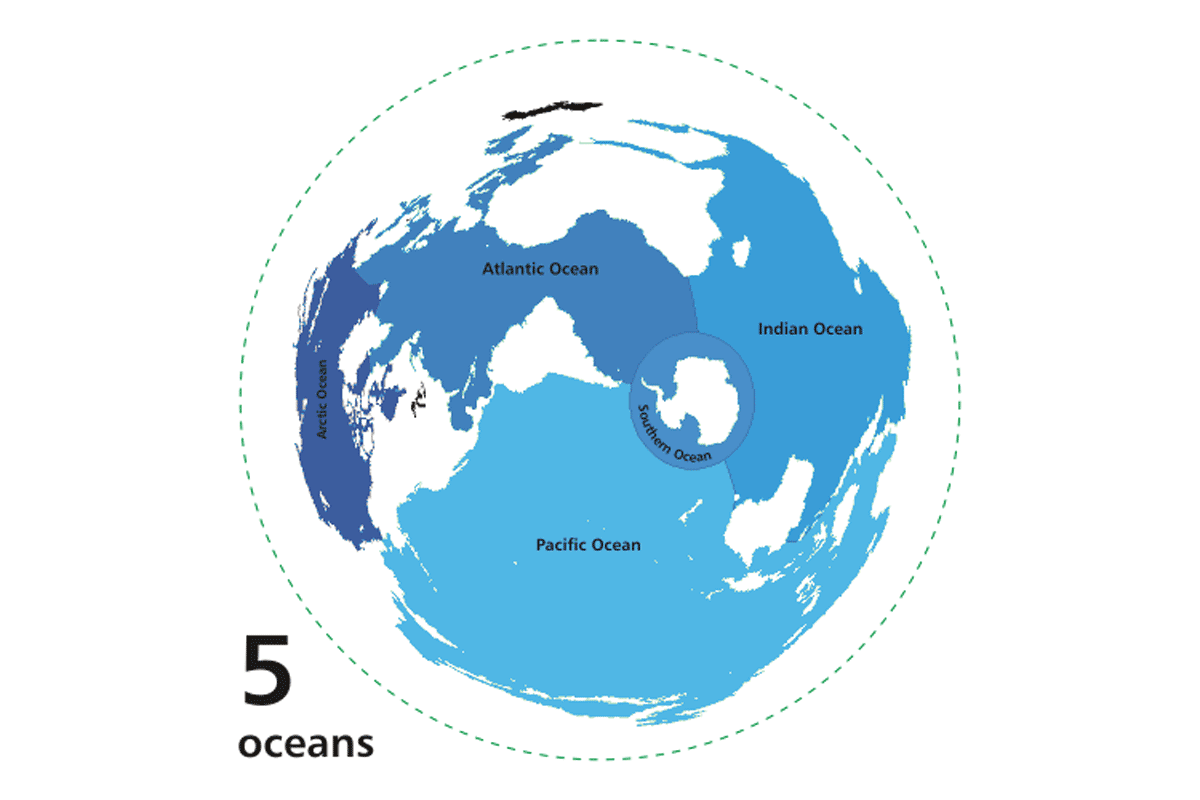
- Younger students can make the five oceans on a world map.
- Older students can make a chart for a geography notebook showing the basic characteristics of each ocean (size, depth, countries bordered, etc.).
- Create a timeline of the major events in ocean exploration.
- Provide a narration (oral or written) describing everything you know about the Mariana Trench.
- Take a side trip and explore gasoline. Explain how its characteristics made it a perfect fuel for descent.
- Explain how the Trieste operated (resources below).
- Add to your notebook facts about the ocean.
Further Investigation
Timeline of Ocean Exploration
Perfect for study and creating a timeline as suggested above. From NOAA.
To the Depths in the Trieste (archived)
Account of the voyage from the University of Delaware.
Trieste Bathyscaphe
Extensive account of the dive hosted at Bluebird Marine Systems.
Trieste
Background on the ship from the Department of the Navy.
Research Vessels: Submersibles – Trieste (archived)
Press releases on the dive.
The Mariana Trench
Facts, figures, and graphics to help understand the deepest place in the ocean, including the role the Trieste played.
Earth’s Oceans: An Introduction
Simple information for younger students from Enchanted Learning.
Activities
Trieste: Family & Children Guide
Free 16-page download from the National Museum of the United States Navy with experiments, biographies, and printables for notebook.
Oceanography Merit Badge Workbook
Free 11-page download for Boy Scout Merit Badge, but works well as a guide to studying oceanography.
Multimedia Discovery Missions (archived)
14 different high-quality interactive missions from NOAA exploring the ocean with video presentation and correlated activities covering plate tectonics, ridges, corals, currents, waves, water cycle, and more.
My Submarine Explorer (archived)
Virtually explore the ocean. From NOAA.
Don’t Get Tide Up
Learn how to read a tidal chart and get the boat under the bridge.
Coral Reef Virtual Tour
Virtual tour of the coral reefs.
Label the Earth’s Oceans
Activity from Enchanted Learning.
Books

The Ocean Book by Frank Sherwin
Covering deep-ocean research, the different physical characteristics of the ocean, icebergs, tides, waves, currents, how weather affects the ocean, ocean resources, marine life, the coral reef, various ocean-exploring vehicles and the Great Flood. A free study guide is also available.
Introduction to Physical Oceanography
Free PDF textbook written to college students, but very accessible.

Twenty Thousand Leagues Under the Sea by Jules Verne
A fun fictional go-along in the public domain. Also available in PDF form.
Glimpses of Ocean Life {Free eBook}
Wonderful introduction to marine biology.
Unit Studies & Lesson Plans
Ocean Explorer
Lesson plans from NOAA exploring the various parts of the ocean.
Update: This resource is no longer available, so we are linking to an archived version.
- Ocean Exploration
Exploring the ocean explorers. - Mapping the Ocean
Bathymetry, or mapping the ocean. - Currents
Science experiment studying deep currents and landforms. - Ocean Geologic Features
Seven scientific activities exploring ocean geology. - Individual Species in the Deep Sea
Exploration of the life under the ocean. Building on the other lessons, this one looks at tubeworms, deep-sea invertebrates, and the people who study them.
Seasonality in the Ocean
Lesson plan comparing the seasons on land with those in the ocean.
Water, Water Everywhere (archived)
Extensive Core Knowledge lesson plan covering islands, oceans, currents, tides, saltwater, waves, and ocean life in seven lessons with culminating project.
Printables & Notebooking Pages
Mariana Trench Graphic
Great printable for notebook illustrating the depth.
Ocean Research
Infographic from USGS for notebook.
The Ocean Notebooking Pages
Simple pages for copywork, narrations, or wrapping up.
These units have been created specifically with do-it-yourself (DIY) homeschoolers in mind: those that don’t want a lot of hand-holding. If this doesn’t describe your need, you might prefer a few of these pre-planned units. For those brave souls who enjoy pulling things together themselves, there are many ways to use these resources!
Keep Reading

Activity: Explore Water
Explore water by investigating its properties through geography, chemistry, and life.

Glimpses of Ocean Life {Free eBook}
Have a young one interested in marine biology? Enjoy Glimpses of Ocean Life by John Harper as a free download.


Geographical Nature Studies ~ Free eBook
Geographical Nature Studies takes the approach of combining nature study with home (or observational) geography.