
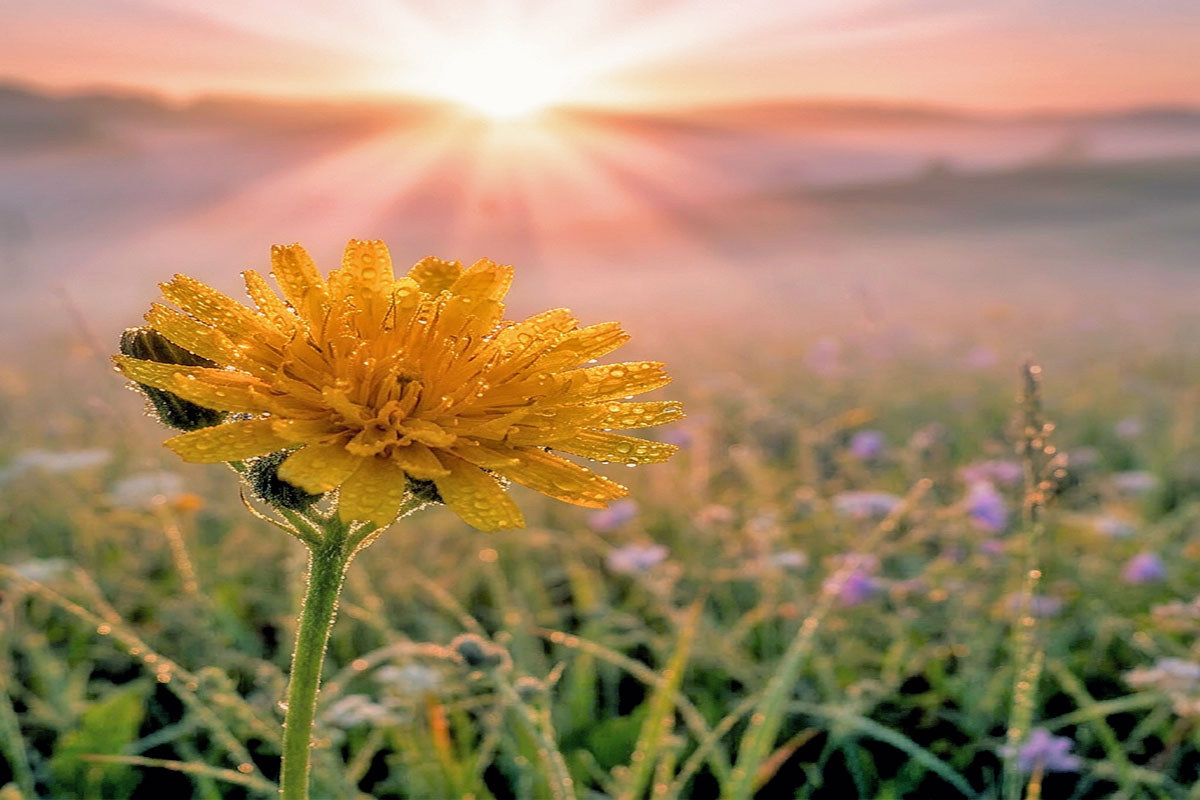

Dear common flower, that grow’st beside the way,
Fringing the dusty road with harmless gold,
First pledge of blithesome May,
Which children pluck, and, full of pride, uphold,
High-hearted buccaneers, o’erjoyed that they
Eldorado in the grass have found,
Which not the rich earth’s ample round
May match in wealth, thou art more dear to me
Than all the prouder summer-blooms may be.
Gold such as thine ne’er drew the Spanish prow
Through the primeval hush of Indian seas,
Nor wrinkled the lean brow
Of age, to rob the lover’s heart of ease;
’Tis the Spring’s largess, which she scatters now
To rich and poor alike, with lavish hand,
Though most hearts never understand
To take it at God’s value, but pass by
The offered wealth with unrewarded eye.
Thou art my tropics and mine Italy;
To look at thee unlocks a warmer clime;
The eyes thou givest me
Are in the heart, and heed not space or time:
Not in mid June the golden-cuirassed bee
Feels a more summer-like warm ravishment
In the white lily’s breezy tent,
His fragrant Sybaris, than I, when first
From the dark green thy yellow circles burst.
Then think I of deep shadows on the grass,
Of meadows where in sun the cattle graze,
Where, as the breezes pass,
The gleaming rushes lean a thousand ways,
Of leaves that slumber in a cloudy mass,
Or whiten in the wind, of waters blue
That from the distance sparkle through
Some woodland gap, and of a sky above,
Where one white cloud like a stray lamb doth move.
My childhood’s earliest thoughts are linked with thee;
The sight of thee calls back the robin’s song,
Who, from the dark old tree
Beside the door, sang clearly all day long,
And I, secure in childish piety,
Listened as if I heard an angel sing
With news from heaven, which he could bring
Fresh every day to my untainted ears
When birds and flowers and I were happy peers.
How like a prodigal doth nature seem,
When thou, for all thy gold, so common art!
Thou teachest me to deem
More sacredly of every human heart,
Since each reflects in joy its scanty gleam
Of heaven, and could some wondrous secret show,
Did we but pay the love we owe,
And with a child’s undoubting wisdom look
On all these living pages of God’s book.
Poems of James Russell Lowell (1917) | James Russell Lowell (1819–1891)
Suggestions
Ask your students to do one or more of the following:
- Poems beg to be read aloud. Read this one aloud, not pausing at the end of every line, but only pausing at the punctuation.
- What is the rhyme scheme? (ABABACCDD)
- Lowell consistently draws on the color of the dandelion in poetic imagery. Note each time he does this. (For example, “Fringing the dusty road with harmless gold.”)
- For each stanza, explain the imagery. Choose your favorite to draw or illustrate. Copy the stanza below the illustration.
- Narrate and explain the last stanza in your own words.
- Learn more about dandelions.
- Read other poems by Lowell.
- James Russell Lowell was known as one of the “fireside poets,” American poets that were popular in the late 1800s whose poems could be read by the entire family around the hearth. Other fireside poets include John Greenleaf Whittier, William Cullen Bryant, Henry Wadsworth Longfellow, and Oliver Wendell Holmes Sr. Read at least one poem by each of these authors. Explain how how the themes are similar.
- Create an author page for Lowell.
Additional Resources
14 Forms of Writing for the Older Student: Poetry
Ideas for doing more with the poem.
