
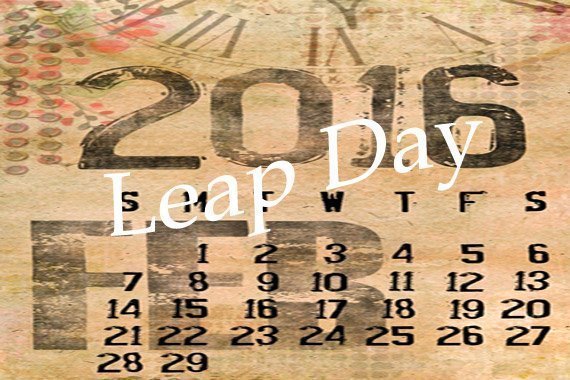

It happens once every four years: February 29th! The leap day of leap years — those years ending in a number divisible by four…well, sort of.
The earth takes 365.24219 days to travel around the sun (equinox to equinox). It is this trip that gives us our year: 365 days each year if we round.
And then there is leap year, when we pick up an extra day in our calendar. Why? Leap year provides that extra 0.24219 of a day. So every four years we add one day, which brings us close to 0.24219 x 4 or 0.96876 or roughly 1 day.
It’s that “roughly 1 day” part that prompted Pope Gregory XIII to change the calendar. The Julian calendar created in AD 325 was ten days off!
The Gregorian calendar, the one we currently use, follows these rules:
- Leap year occurs every four years in years that are evenly divisible by four (2016/4=504).
- There is no leap year in years ending with 00 unless the first two digits of the year are evenly divisible by 4 (1800 was not a leap year).
So happy Leap Day!
Suggestions
Have your students do one or more of the following:
- Using the instructions above, make a list of leap years through 2100.
- Calculate how far off our calendar would be in the year 3000 if we did not have leap day beginning in the year 2000.
- Explain what a solar year is.
- Learn how long a year is on other planets.
- What do you recommend a person do for their birthday each year when they are born on February 29th?
- Learn more about the Gregorian calendar.
Additional Resources
What is a Leap Year
Perfect explanation for kids from NASA.
The Science
From the National Air and Space Museum.
Activities
Activity: Using a Calendar
Ready to introduce your child to the calendar? Step-by-step suggestions for helping a child become time aware.
Math
From the Jet Propulsion Lab.
Calculations
An interactive calculator to determine if a year is a leap year.
Science World
Calculate the probability that a baby will be born on Leap Day.
How Long is a Year on Other Planets
Great interactive for kids from NASA.
Unit Studies & Lesson Plans
Celebrate! (archived)
Lesson plan from Scholastic that looks at Leap Day math and … frogs.

Gregorian Calendar: A Unit Study
More about leap year along with lots of calendar activities, printables, and more!
These units have been created specifically with do-it-yourself (DIY) homeschoolers in mind: those that don’t want a lot of hand-holding. If this doesn’t describe your need, you might prefer a few of these pre-planned units. For those brave souls who enjoy pulling things together themselves, there are many ways to use these resources!
Keep Reading

Create Your Own Calendar Jan Brett ~ Free
This free interactive calendar from Jan Brett features beautiful artwork for each month

Golden Numbers Book of Verse ~ Free eBook
Golden Numbers: A Book of Verse for Youth is a free book of poems intended to put a student on a path to loving…

The Equinox: A Unit Study
The equinox is the time of year when the sun is in the same plane as the earth’s equator. Unit resources.