
The telephone as we know it is almost nothing like it was when it first appeared. The basic principle of producing and sending sound is the same. But many improvements and solutions have been worked out since the early days.
Table of contents
The First Telephone
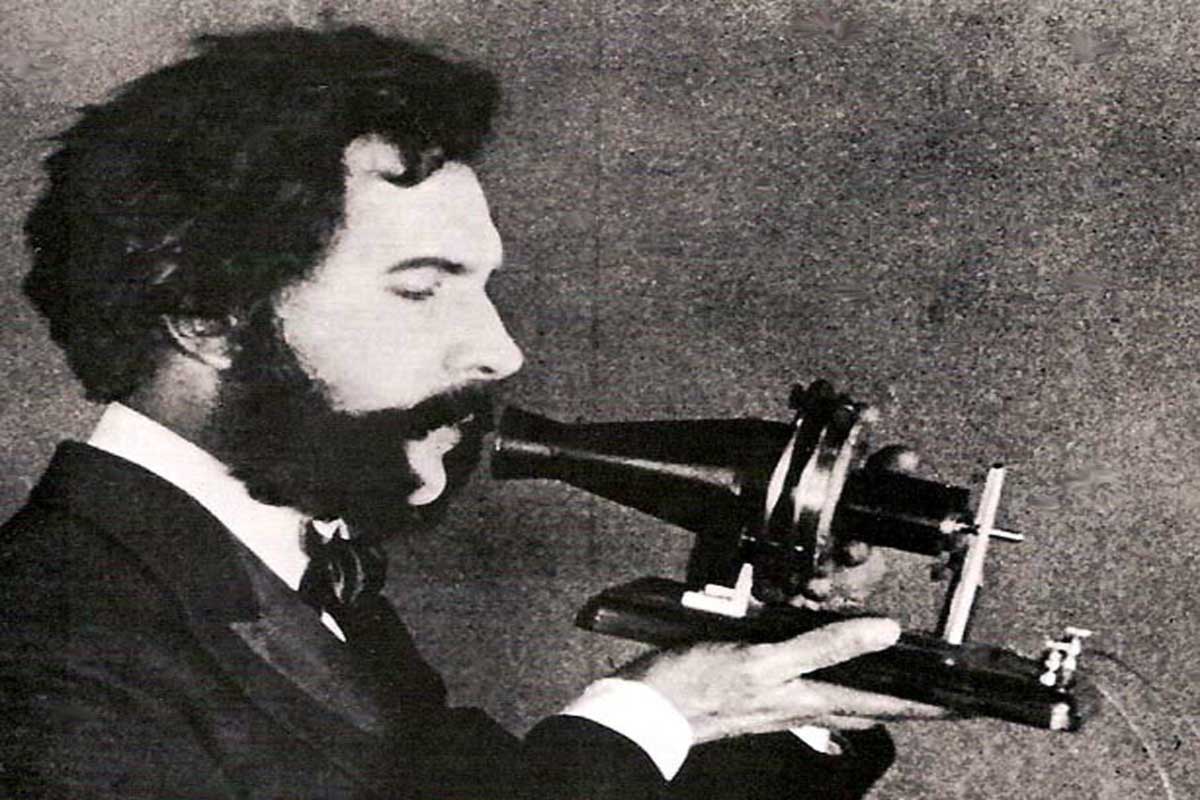
The first telephone was invented by Alexander Graham Bell in 1875. This telephone was a primitive device but the first to transmit a human voice.
The original phone consisted of a diaphragm that vibrated to sound waves, a magnet, and a coil of wires. As the diaphragm vibrated, it moved the magnet, which was near the large coil of wires. Accordingly, an identical reproduction of the sound was inducted into the coil. By running the current through another device of the same type, the sound could again be created — even at a long distance from its origin.
In 1877 Bell improved the telephone further by putting it into a box with a mouthpiece to talk into — or, as was really the case, shout into. The new design was rather bulky and limited in its abilities, so a team of professors quickly modified it further. Although they increased its efficiency and reduced its size, it continued to be a primitive device.
Edison’s Telephone
But the telephone was yet to be improved. At the time, telegraphy was the standard used to transmit messages over distance. Obviously, the telephone could compete with telegraph technology.
A telegraph company hired the famous inventor of the incandescent light bulb, Thomas A. Edison, to make a telephone that wasn’t covered by Bell’s patents. That Edison did. He very quickly made a telephone that ran battery power through carbon. As Bell’s telephone used magnetic induction instead of carbon, the telegraph company would not have to pay Bell for his work.
The new carbon phone worked because carbon changes its resistance and therefore the flow of current through it when under pressure. Thus, Edison not only made a workable telephone, but one much more efficient than Bell’s. A greater change in current could be produced, which in turn resulted in increased volume.
The Telephone Switchboard

Creating a working telephone was only half of the battle. The next challenge was inventing a workable telephonic system.
To manage the incoming and outgoing messages, the original solution was to man a large switchboard with operators who were signaled to connect the appropriate lines and in turn signal the person receiving the telephone call.
Originally signaling the receiver of the call implied everyone’s phone needed to ring. Each person, therefore, would count the rings, and if it was the right number of rings, he or she would pick up the receiver. Often times more than one person would pick up, so any number of ears could be listening to a conversation.
Since the operators could be slow and make mistakes, a dissatisfied telephone owner designed an automatic switch to connect the appropriate lines.
The Telephone Network

Yet another problem to be resolved was the transmission lines. As more people became attached to the system, the phone lines would have to cover a longer distance, leading to serious signal loss.
In 1913, a three element vacuum tube (predecessor of today’s transistors) became available. This allowed the amplification necessary to increase signals within reasonable distortion levels.
A few years later, with the aid of a triode oscillator, several messages could be sent on the same line by simply putting them at different frequencies.
Later, a more efficient system of coaxial cables and lines came into place employing microwave frequencies. But even that was to become obsolete when wireless transmitters were developed, first using microwave frequencies, and then using today’s satellites.
Even though the telephone has immensely improved since its beginnings, the general design is basically the same as the one that Alexander Graham Bell dreamed up. However, the phone technology systems have greatly advanced and are almost nothing like the primitive telephone on which Alexander Graham Bell transmitted his famous words, “Mr. Watson, come here, I want you,” on March 10, 1876.
Suggestions
- Tell the story of the development of the telephone.
- Explain the fundamentals of how a telephone works.
- Read the section on Bell from the book Great Inventors and their Inventions below. Write a character study of Bell (or trading card for younger students).
- Take a side trip and learn more about Thomas Edison.
Further Investigation
The First Telephone (archived)
Information from the Library of Congress for kids site.
Telephone History Timeline
From AT&T.
The First Telephone (archived)
Photo gallery of the first telephone and those following. Be sure to click on the more detailed photos.
Bell’s First Patent
Full text.
Timeline of Alexander Graham Bell
From the Library of Congress.
Alexander Graham Bell
Biography from MIT.
Activities
Bell’s Path to the Telephone
Interactive timeline from the Institute of Advanced Technology of electronic progress leading to the invention of the telephone.
String Telephone
Experiment at TeachEngineering.org to demonstrate how early telephones worked.
Alexander Graham Bell Activity Book
48-page download.
Books
History of the Telephone by Herbert Newton Casson
Free eBook that provides extensive but interesting coverage.
Great Inventors and Their Inventions by Frank Bachman
This popular free eBook contains a 19-page chapter titled “Alexander Graham Bell and the Invention of the Telephone.”
Unit Studies & Lesson Plans
Unit Study: Lines of Communication (archived)
Research and activities covering Bible, science, language arts, social studies, math, art, health, and music. (Please note: Bell’s quote to Watson and his successful experiment has been given an incorrect date.)
The History of the Telephone
Teacher lesson plan that explores how telephones have changed over time.
The History of the Telephone
Student version.
Free Science Studies: Alexander Graham Bell & the Telephone
Part of our free science studies.
Printables & Notebooking Pages
Alexander Graham Bell Coloring Page (archived)
For notebook from Crayola.
The Telephone Notebooking Pages
Simple pages for copywork, narrations, and wrapping up.
These units have been created specifically with do-it-yourself (DIY) homeschoolers in mind: those that don’t want a lot of hand-holding. If this doesn’t describe your need, you might prefer a few of these pre-planned units. For those brave souls who enjoy pulling things together themselves, there are many ways to use these resources!
Keep Reading

Free Science Studies: Great Inventors & Their Inventions
Great Inventors & Their Inventions covers inventors and inventions that have shaped history. 32 free lessons!

Historic Inventions ~ Free eBook
Historic Inventions is told in story form, making it a great complement to our free science studies series! 16 inventions and their inventors.

10 Ways to Use Notebooking: #7 Science
From early sketches of observations to inventions and diagrams. 10 Ways to Use Notebooking: #7 Science