
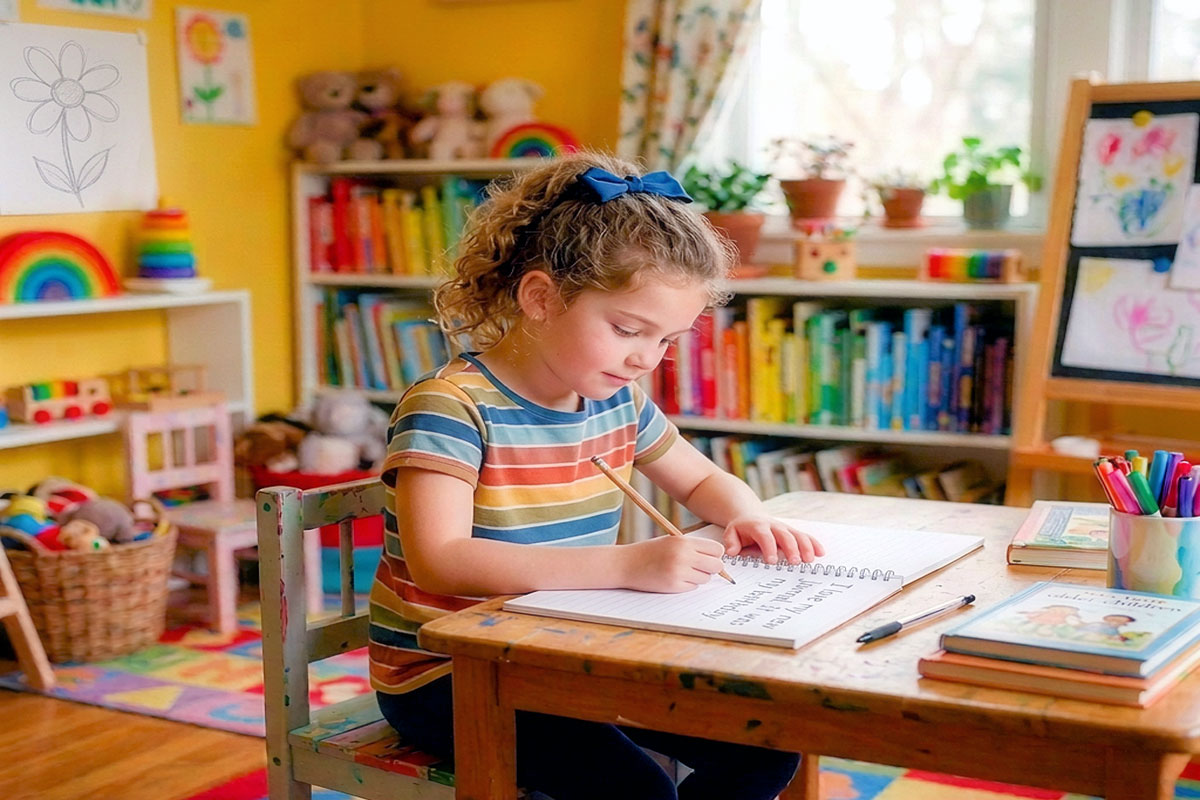

Yes, they must learn to write their letters and practice their handwriting. But “writing” is more than the simple mechanics of holding a pencil. Here are 8 writing activities for young students as they develop their mechanical skills:
1. Tracing.
One way for a younger student to practice his handwriting is to trace the letters of the alphabet.
But handwriting practice doesn’t have to equate to repeatedly tracing a string of the same letter. Mix it up. Use a handwriting worksheet creator and let him trace favorite lines from stories of interest.
2. Copywork.
Copywork can be comprised of one word, one phrase, one sentence, or one paragraph depending on your child’s level of ability.
If possible, let him choose his own copywork from a favorite read. Choose worthwhile sentences. This process provides input that will result in creative output down the road.
3. Booklet writing.
Here is where your long-arm stapler comes in handy!
At one point we had dozens of booklets lying about in various stages of completion. A booklet is small and inviting. Hand one to a child, and he will find a way to fill it.
The simplest booklet to make: Fold several sheets of 8 1/2 x 11 paper in half and staple in the middle. Consider this the first step on the path to notebooking.
4. Written narration.
After reading a favorite book, have him tell you what happened; or for a longer book, what happened in a particular scene. Depending on his ability, you may need to have him dictate his narration to you and insert it into a handwriting worksheet generator or print it on paper for him to copy. Keep it simple.
5. Dictation.
In the beginning, dictation works best after copywork.
Have your student study what will be dictated, going over any unknown words, difficult spellings, punctuation, or capitalization. Then dictate the passage to him slowly. Again, choose writing models worthy of studying.
6. Writing from a model.
Have your child use a favorite short story as a model to create his own similar short story.
Sometimes reference books work best as they remove the pressure to be creative, letting a child write what he knows rather than being required to invent something.
7. Letter writing.
Depending on his level, he can dictate to you and you can create the format for him to copy on another sheet of paper.
Or he can copy a model from an English grammar book, modifying the model to suit his purpose.
You can also adapt our letter writing tips for older students.
8. Write something every day.
His choice. Whether copying from favorite passages or working on the next great novel, instilling the habit of writing every day will be the one thing that will have the biggest effect on his writing.
As Dr. Ruth Beechick states, “Learn to write, write.”

Learn to Write, Write!: A DIY Writer’s Companion
Ready to get started writing? Learn to Write: Write! is your guide to discovering and practicing the art of writing. Cover the basics, such as finding something to write and overcoming fears, to more advanced topics like revising your work and cultivating your voice and style. The book gets out of the way as great writers and their writing encourage you to apply their ideas to your own writing. Put pencil to paper and stretch your abilities as you learn by doing. Learn more.
Additional Resources

Write Something Every Day: 366 Pencil Sharpeners for Students of Writing
Our own book includes copywork, written narration, booklet writing, dictation, writing from a model, and much more! This huge 554-pg. resource provides carefully crafted writing prompts and challenges for each day. We use nearly 20 different forms of writing to keep the student engaged. Also included are writing instruction, tips for modifying assignments for “younger writers,” and other resources. Learn more.
Activity: Tracing
The first step on the path to writing.
Activity: Copying
Learn to write by copying the best.

10 Ways to Use Notebooking: #2 Copybook
The beginning of a lifelong adventure, and suggestions for getting started.
Language Arts the Natural Way: Narrating
Tips and suggestions.
Language Arts the Natural Way: Dictation
Tips and resources.

10 Ways to Use Notebooking: #4 Writing
More suggestions for writing every day.
Sheldon’s Primary Language Lessons
Model letter in Lesson XLVI (page 62) and exercises in letter writing in Lesson LXXV (page 101).
Printables & Notebooking Pages
Handwriting Worksheet Creator
Invaluable free tool that allows you to create copywork sheets. These can be used for tracing or copywork by leaving blank lines at the bottom of the printing.
Interactive Flip Book Maker
What is your child interested in? Bugs? Letters? Dogs? Rocks? Lots of ways to use a flip book.
Shape Books {Free}
Interesting paper to get those creative juices flowing!
Drawing & Writing Notebooking Paper {Free Download}
Room to illustrate at the top and write descriptions or narrations underneath.
Keep Reading


Activity: Storytelling Prompts
Storytelling prompts encourage a student step by step through the process of creating his own story.

Activity: Rhyming Couplets
Rhyming couplets are two consecutive lines of poetry that have the same sound at the end.