

Engines have long been used for the production of useful energy to do work, such as pumping water and driving a vehicle. The common theme, however, is the utilization of the combustion of substances to provide either heat or expanding gasses.
External vs. Internal Combustion Engines
The external combustion engine uses the burning of fuel to indirectly heat the substance doing the work.
The steam engine is the basic external combustion engine. A fire boils water in a tank, the steam produced is then channeled into a cylinder where it does the work.
An internal combustion engine, by contrast, relies on the burning of fuel in a combustion chamber where the expanding gasses do work.
The History of the Internal Combustion Engine
The internal combustion engine has been around for a long time. The modern version of the engine is now over a century old.
Versions of the internal combustion engine were being proposed as early as the 1600s. Those models used gunpowder for fuel, and were designed to pump water — but were never built. How to ignite the gunpowder and then to keep the engine running in a controlled fashion proved to be an insurmountable difficulty.
George Brayton

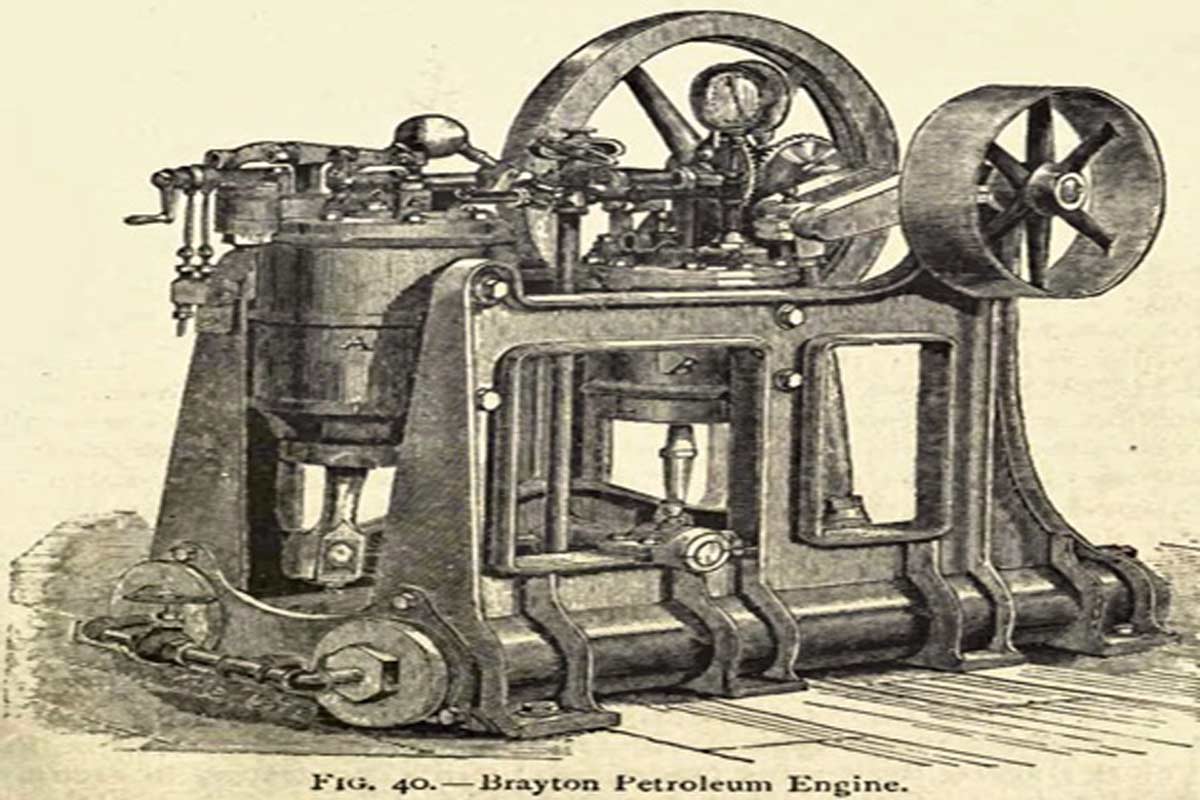
Over a century later, George Brayton was born on October 3, 1830. Brayton pioneered the first successful (and safe) oil-powered engine.
Brayton’s engine compressed air and then sent it into the combustion chamber, which had twice the volume of the compression chamber. On its way to the combustion chamber, the air passed through a fuel-soaked “absorbent material,” and picked up fuel vapors on its way.
The fuel could be either gasoline or kerosene. Kerosene was preferred, as gasoline proved to be a little too unstable for the Brayton engine.
The fuel/air mixture was ignited by a pilot flame kept burning in the combustion chamber. The gas produced by combustion forced the piston down, where the momentum of the engine then pushed it back up again for another combustion stroke.
As these engines weighed an enormous amount they were mostly used for stationary purposes, although they occasionally found their way into an automobile or two.
The Four-Cycle Internal Combustion Engine
The modern four-cycle engine uses two valves and a piston. First a valve opens, allowing the fuel/air mixture into the engine. The valve closes, and the mixture is compressed by the cylinder. A spark, produced by a spark plug in the top of the engine, ignites the mixture once it is fully compressed. The mixture expands drastically, forcing the cylinder down, and the other valve opens allowing the exhaust to escape.
This engine, invented in the 1800s, is still employed to this day, being one of the premier engines of all time. Although it is not the Brayton engine, there can be no doubt that Brayton’s patent for the first commercial gas-powered internal combustion engine laid the groundwork for the safe and practical use of oil products for fuel.
Suggestions
Have your students do one or more of the following:
- Compare and contrast the internal vs. external combustion engine.
- Learn more about James Watt.
- Narrate the process by which a modern internal combustion engine works.
- Learn to change the oil in an engine. Explain why this is important.
- Compare and contrast the two-stroke vs. four-stroke engine (see below).
Further Investigation
George Brayton
Biography from the American Society of Mechanical Engineers.
History of the Internal Combustion Engine (archived)
This 4-page document includes a great timeline.
How an Engine Works — Animation
Excellent explanation of how the internal combustion engine works.
(You may want to install an ad blocker before viewing.)
Brief History of the Internal Combustion Engine
From the 1600s to the modern 4-cycle.
Brayton Cycle
How Brayton’s work is still being used today.
History of Engines (archived)
How a modern internal combustion engine works.
Activities
Two Stroke Engine
Interactive animation and explanations.
Four Stroke Engine
Interactive animation and explanations.
Internal Combustion Engines ~ Animated
Each animated illustration can be interacted with, rotated, or stopped.
How to Change Your Oil
Step-by-step instructions for something everyone probably should know how to do!
Books
A Power Primer
Excellent introduction for younger students from General Motors. Free.
Internal Combustion Engine Manual
Public domain work that explains the four parts of the engine in easy-to-understand language.

Gas and Petroleum Engines {Free eBook}
Public domain work that takes a practical, hands-on view. Many helpful illustrations for the history buff.
Practical Hand Book of Gas, Oil, and Steam Engines by John Rathbun
Everything you need to know in this public domain work.
Unit Studies & Lesson Plans
Understanding Principles of Operation of Internal Combustion Engines
Extensive lesson plan from New Mexico Agriculture Education and FFA.
Internal Combustion Engines
Course that is part of MIT’s OpenCourseware program.
Printables & Notebooking Pages

2-Cycle Engine
Diagram for notebook.

4-Cycle Engine
Diagram for notebook.
Internal Combustion Engine Notebooking Pages
Simple pages for copywork, narrations, or wrapping up.
These units have been created specifically with do-it-yourself (DIY) homeschoolers in mind: those that don’t want a lot of hand-holding. If this doesn’t describe your need, you might prefer a few of these pre-planned units. For those brave souls who enjoy pulling things together themselves, there are many ways to use these resources!
Keep Reading

Activity: James Watt Study
In this activity, students will learn more about Watt, explore the uses of steam, and understand the three states of matter.

Gasoline: A Unit Study
Gasoline is a necessity required by cars, generators, mowers — anything that requires an engine to operate. Unit resources.


Drake’s Oil Well: A Unit Study
Edwin Drake, born on March 29, 1819, created the first oil-producing well. Unit resources.