


Although not officially opened for traffic until November 17, 1869, on February 17, in 1867 the first ship made a transit of the Suez Canal. The passage has had a wide and varied history starting in ancient times when it is believed Senausert III Pharaoh of Egypt (1874 BC) dug a canal connecting the Mediterranean Sea with the Red Sea. It is also believed that this canal was abandoned and reopened several times afterward. Evidence of a canal along the Wadi Tumilat that was built by Persian ruler Darius I (522–486 BC) can still be seen today.
Where is the Suez Canal?
Today the Suez Canal runs from Port Said to the Gulf of Suez. Excavation of the canal began April 25, 1859, and on November 17, 1869, the canal was completed, allowing ships to pass directly from the Gulf of Suez to the Mediterranean Sea bypassing the trip around the Cape of Good Hope on the Horn of Africa.
The canal has been enlarged many times since, allowing larger ships, including partially loaded supertankers, to pass through the lockless system. As of 2010 it was approximately 120 miles in length, 673 feet wide, and approximately 79 feet deep.
How Long Does it Take to Travel Through the Suez Canal?
A typical day on the canal will see three convoys of ships traverse its length, two northbound and one southbound. Transit time is between 11 and 16 hours at a speed of about 8 knots. This speed minimizes the erosion of the canal banks by the wakes produced as the ships pass.
Two-way passage of ships is not possible in the canal, but there are several passing bays and areas where ships may pass each other in the Bitter Lakes.
What is the Importance of the Suez Canal?
The Suez Canal is an important link in worldwide distribution of goods. About 8% of the world’s total shipping passes through the canal, greater than 17,000 ships per year. Approximately 5% of the world’s oil passes through the canal along with 15% of the world’s liquefied natural gas. Any disruption in the daily operation would most likely add an additional 16 days of transit time and associated costs to navigate around Africa.
Here is a Red Sea. It is a long, narrow sea bordering Arabia. I don’t know why it’s called Red, unless it is because it’s red hot, for I have been there and the water is as blue as the Mediterranean. There is a little strip of land that used to separate the Red Sea from the Mediterranean, but men have dug a canal through this strip of land so that ships may pass from one sea to the other. This strip of land is the Isthmus of Suez and the canal across it is called the Suez Canal.
The Suez Canal is one of the most important canals ever dug. It is important because, before it was dug, this little isthmus that tied together the two big continents of Africa and Asia, barred the way to ships and they had to go all the way around Africa to get to the east side of the World.
A Child’s Geography of the World by V.M. Hillyer
Suggestions
Have your students do one or more of the following
- Locate and label the Red Sea on a map.
- Locate and label the Mediterranean Sea on a map.
- Find out what an isthmus is.
- Locate and label the Isthmus of Suez.
- Locate and label the Suez Canal.
- Find the continents of Africa and Asia.
- Chart a path on a globe from London, England, to Bombay, India, without using the Suez Canal route.
- Now chart a path on a globe from London to Bombay using the Suez Canal.
Further Investigation
Building of the Suez Canal
Nice timeline.
History of the Suez Canal
From the Suez Canal Authority.
Suez Canal Photos
Multimedia presentation of the history of the canal.
Suez Canal Crisis (archived)
Interesting investigation of the 1956 Suez Canal Crisis from Nova.
Isthmus
Explanation with photos from National Geographic.
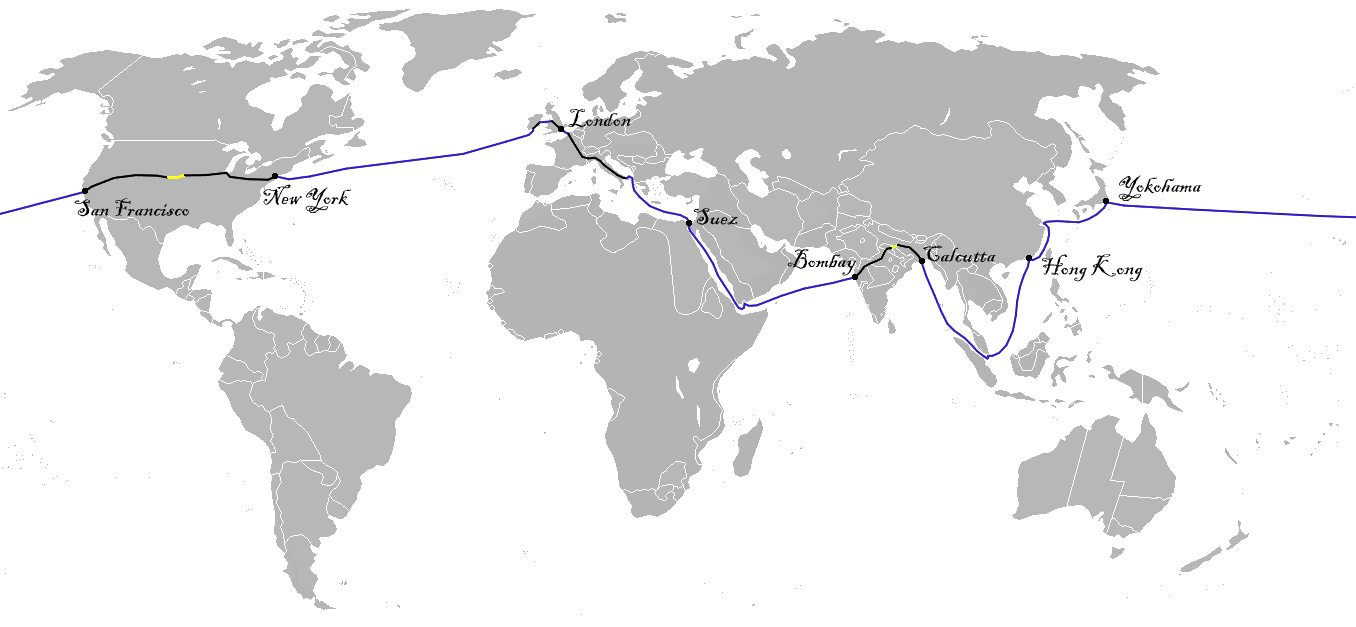
Around the World in Eighty Days Map
This map that goes with the book by Jules Verne shows the main character’s route from London, England, to Bombay, India. How did you do?
Activities
Steer Through the Suez Canal
Interactive from CNN.
Unlocking Canal Locks
Rather complicated clay lesson activity from Crayola.
Books
The History of the Suez Canal: A Personal Narrative by Fredinand de Lesseps
Public domain history from the French diplomat responsible for the development of the canal.
Unit Studies & Lesson Plans
Rivers and Canals
3-page download at the London Canal Museum exploring the similarities and differences between the two.
The Suez Canal Crisis
15-page download from the National Museum of American Diplomacy with excellent maps.
Printables & Notebooking Pages
Map of Egypt
Showing the Suez Canal for notebook.
Africa & Asia
Physical map for marking at EduPlace.com.
Suez Canal Notebooking Pages
Simple pages for copywork, narrations, or wrapping up.
These units have been created specifically with do-it-yourself (DIY) homeschoolers in mind: those that don’t want a lot of hand-holding. If this doesn’t describe your need, you might prefer a few of these pre-planned units. For those brave souls who enjoy pulling things together themselves, there are many ways to use these resources!
Keep Reading

Ships & Ways of Other Days ~ Free eBook
For someone with an interest in sailing ships, Ships & Ways of Other Days will be an engaging read. Free eBook.

Jules Verne: A Unit Study
Jules Verne was born on February 8, 1828, at a time and a place of rapid scientific developments. Unit resources.

A History of Navigation ~ Free Interactive
A History of Navigation is a BBC interactive that explains the era of exploration in the 15th and 16th centuries.