
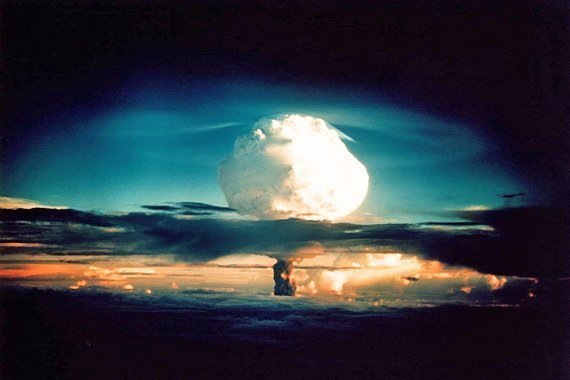

On November 1, 1952, the United States detonated the first hydrogen bomb. The bomb, codenamed Mike, was detonated at 7:15 AM on the island of Elugelab in the Marshall Island group, completely vaporizing the island and leaving behind a crater beneath sea level more than one mile wide and 164 feet deep. Within the first 90 seconds after the blast the fireball reached 57,000 feet high, ultimately reaching 120,000 feet. The yield of the explosion was equivalent to a staggering 10.4 megatons of TNT, containing as much force as all the bombs dropped on Germany and Japan in World War II and 450 times more powerful than the bomb dropped on Nagasaki.
Operation Ivy
Mike was part of a larger program, code-named Operation Ivy. Ivy was established by President Harry S. Truman to counter efforts by the Soviet Union to become the first country to add thermonuclear weapons to their arsenal.
Joint Task Force 132 was assigned the responsibility for carrying out the “Mike” test. It was comprised of members from all branches of service and many renowned scientists.
Work began in March of 1952 to prepare the area for testing. One aircraft carrier and four destroyers as well as more than 80 aircraft were placed close to the test area to support the effort.
A two-mile-long tunnel was dug connecting two islands and filled with helium balloons and sensors to monitor the progress of the fusion reaction.
Ulam-Teller Design

Mike was the first test of a hydrogen bomb based on the Ulam-Teller concept. Designed by Richard Garwin, this staged device used a fission bomb primary. The primary was an atomic bomb similar to the those dropped on Hiroshima and Nagasaki in Japan during WWII. The primary exploded a fusion bomb secondary made out of hydrogen. The hydrogen secondary used liquid deuterium, one of two stable isotopes of hydrogen occurring in nature.
Deuterium requires a cryogenic cooling system to be maintained as a liquid. Therefore it was known that liquid deuterium could not be used in a deploy-able weapon. But it could be used as a proof of concept to put the U.S. at least a year ahead of the Soviet Union in developing such a device.
Mike was physically huge with the entire assembly housed in a steel case 80 inches wide and 244 inches long. It walls were 10 to 12 inches thick and wegiht 82 tons. A six-story building was required to contain the bomb and all of the equipment needed for the experiment.
What is a Hydrogen Bomb?
Critical mass can be defined as the smallest amount of fissile material in a given area required to sustain a nuclear chain reaction. If the critical mass is exceeded, one nuclear reaction causes an average of more than one nuclear reactions releasing significant energy as the radioactive atoms come apart.
As larger and larger masses are considered for a larger explosion, it becomes increasingly difficult to achieve the forces required to compress them efficiently to explode all of the available radioactive material. Hence, a bomb that relies on a fusion reaction is self-reacting once it is triggered. Theoretically there is no limit to the amount of explosive force that could be released in the detonation.
Physicist Herbert York noted after the Mike explosion, “It seemed we had learned how to brush even these limits aside [the limits of the atomic bomb] and to build bombs whose power was limitless.”
Mutually Assured Destruction (MAD) Theory
The Soviet Union, as well as a handful of other countries, was quickly developing similar technology.
All of the pieces were in place for the Cold War’s policy — that of Mutually Assured Destruction or MAD. With bombs positioned in strategic locations, it was guaranteed that not all could be destroyed by an aggressor nation. The attacked nation would still maintain enough destructive force to guarantee the complete elimination of the aggressor nation’s population.
Suggestions
Have your students do one or more of the following:
- Map the island of Elugelab in the Marshall Island group.
- Create a timeline showing the development of the hydrogen bomb.
- Create a compare/contrast map showing the positive and negative points of the hydrogen bomb.
- Explain the difference between fission and fusion.
- Write a persuasive essay reflecting your opinion on some aspect of the hydrogen bomb’s history and/or technology.
Further Investigation
Ivy Mike — First Hydrogen Bomb Test
From “Dr. Teller’s Very Large Bomb,” a PBS documentary. Includes description of how the bomb works. (You may want to install an ad blocker before viewing.)
Operation Ivy
Background information, photos and videos.
“Mike” Test (archived)
Background from PBS.
Race for the Superbomb: Timeline (archived)
From PBS.
Operation Ivy
30-minute video from the Federal Civil Defense Administration. Excellent resource!
(You may want to install an ad blocker before viewing.)
Nuclear Weapons Test Map (archived)
Showing the locations of nuclear tests around the world. From PBS.
Activities
Interactive Timeline
Timeline creator at ReadWriteThink.
Compare and Contrast Map
Interactive application at ReadWriteThink helpful for the suggestions above.
Persuasion Map
Interactive at ReadWriteThink that helps you develop a persuasive essay.
Unit Studies & Lesson Plans
Is Control of Nuclear Weapons Necessary to Maintain Peace?
Extensive lesson plan from the Truman Library focusing on primary sources.
Fusion: The Hydrogen Bomb
Includes a portion of the PBS American Experience video “Race for the Superbomb.” The support materials include a background essay and discussion questions.
Printables & Notebooking Pages
World Pacific
Eduplace map for locating Elugelab.
Hydrogen Bomb Notebooking Pages
Simple pages for narrations or wrapping up.
These units have been created specifically with do-it-yourself (DIY) homeschoolers in mind: those that don’t want a lot of hand-holding. If this doesn’t describe your need, you might prefer a few of these pre-planned units. For those brave souls who enjoy pulling things together themselves, there are many ways to use these resources!
Keep Reading

Smokey Bear: A Unit Study on Fire & Fire Safety
On August 9, 1944, Smokey Bear was born. Fire safety unit resources.

Activity: Explore Water
Explore water by investigating its properties through geography, chemistry, and life.

Liberty Bell 7 ~ Free Rocket Unit
Free 27-page unit study for grades 4–8 covering rockets, space flight, and astronauts based on the flight of Liberty Bell 7.