

Between the dark and the daylight,
When the night is beginning to lower,
Comes a pause in the day’s occupations,
That is known as the Children’s Hour.
I hear in the chamber above me
The patter of little feet,
The sound of a door that is opened,
And voices soft and sweet.
From my study I see in the lamplight,
Descending the broad hall stair,
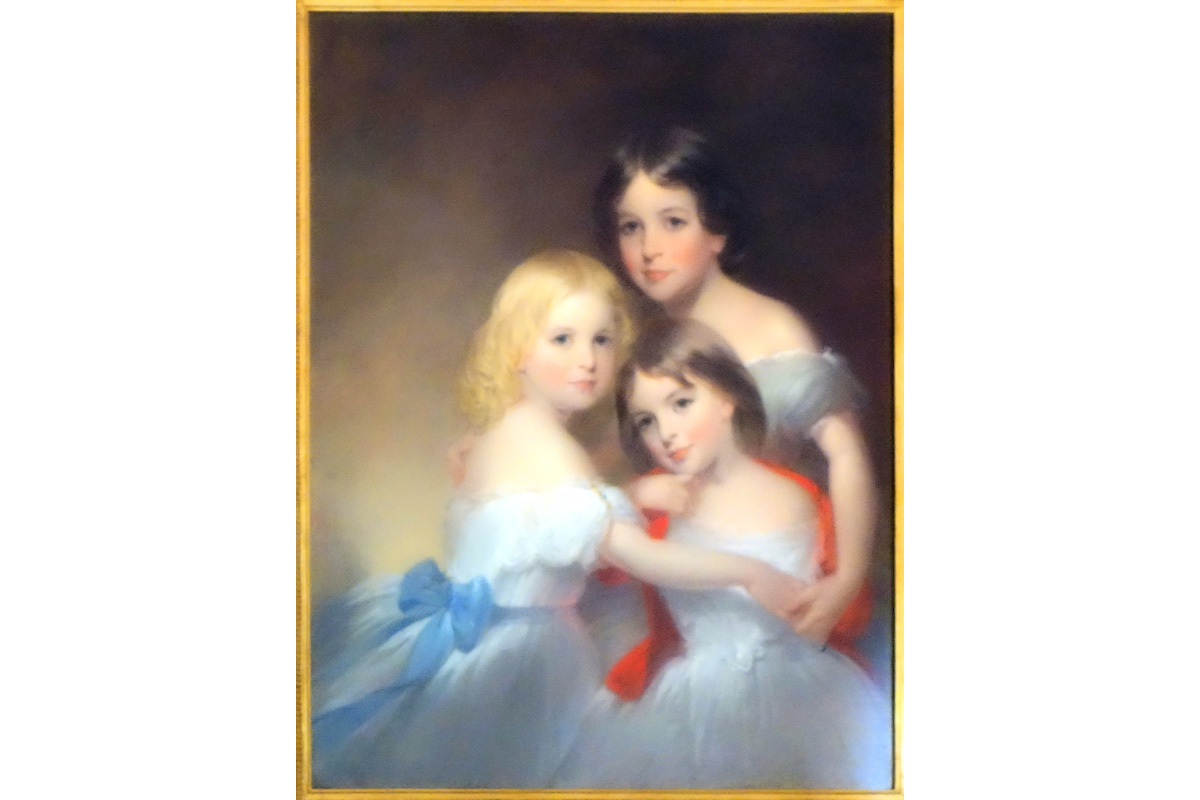
Grave Alice, and laughing Allegra,
And Edith with golden hair.
A whisper, and then a silence :
Yet I know by their merry eyes,
They are plotting and planning together
To take me by surprise.
A sudden rush from the stairway,
A sudden raid from the hall!
By three doors left unguarded,
They enter my castle wall!
They climb up into my turret,
O’er the arms and back of my chair;
If I try to escape, they surround me;
They seem to be everywhere.
They almost devour me with kisses,
Their arms about me entwine,
Till I think of the Bishop of Bingen
In his Mouse-Tower on the Rhine!
Do you think, O blue-eyed banditti,
Because you have scaled the wall,
Such an old moustache as I am
Is not a match for you all?
I have you fast in my fortress,
And will not let you depart,
But put you down into the dungeon
In the round-tower of my heart.
And there will I keep you forever,
Yes, forever and a day,
Till the walls shall crumble to ruin,
And moulder in dust away!
The Children’s Hour, Paul Revere’s Ride, and Other Poems (1894) | Henry Wadsworth Longfellow (1807–1882)
Suggestions
Have students work through one or more of the following exercises depending on age:
- Copy the poem on Drawing and Writing paper.
- Narrate the poem.
- Determine the rhyme scheme (ABCB).
- Write a stanza of a poem of your own that follows the same rhyme scheme. For those that find this difficult, rewriting a stanza of Longfellow’s may be easier. For example:
- Between the dawn and the evening,
When the light is reaching its height,
Comes the activity of the day’s occupations,
That is known as the Daily Nine-to-Five.
- Between the dawn and the evening,
- Read more about the legend of the mouse-tower immortalized by Southey. (May not be suitable for younger family members.)
- View a photo of the Mouse-Tower.
- Identify each of Longfellow’s daughters in the portrait above by his description of them in the poem. (Annie Allegra right front; Edith left, and Alice Mary right rear.)
- Rewrite the poem as a short story.
- Read a biography of Longfellow.
- Narrate what you learn on an Author Notebooking page.

Additional Resources

Poetry for Young People: Henry Wadsworth Longfellow
While we have enjoyed this illustrated series as an introduction to various poets — Longfellow being a favorite — others might object to the sometimes-abridged versions of some poems appearing inside. The choice, as always, is yours!
The Children’s Hour and Other Poems
Read online.
Free History Studies: Henry Wadsworth Longfellow
Henry Wadsworth Longfellow was an American poet whose love of children earned him the nickname “The Children’s Poet.” Unit resources.
You’ll find other Longfellow poems in our Online Poetry Anthology:
