
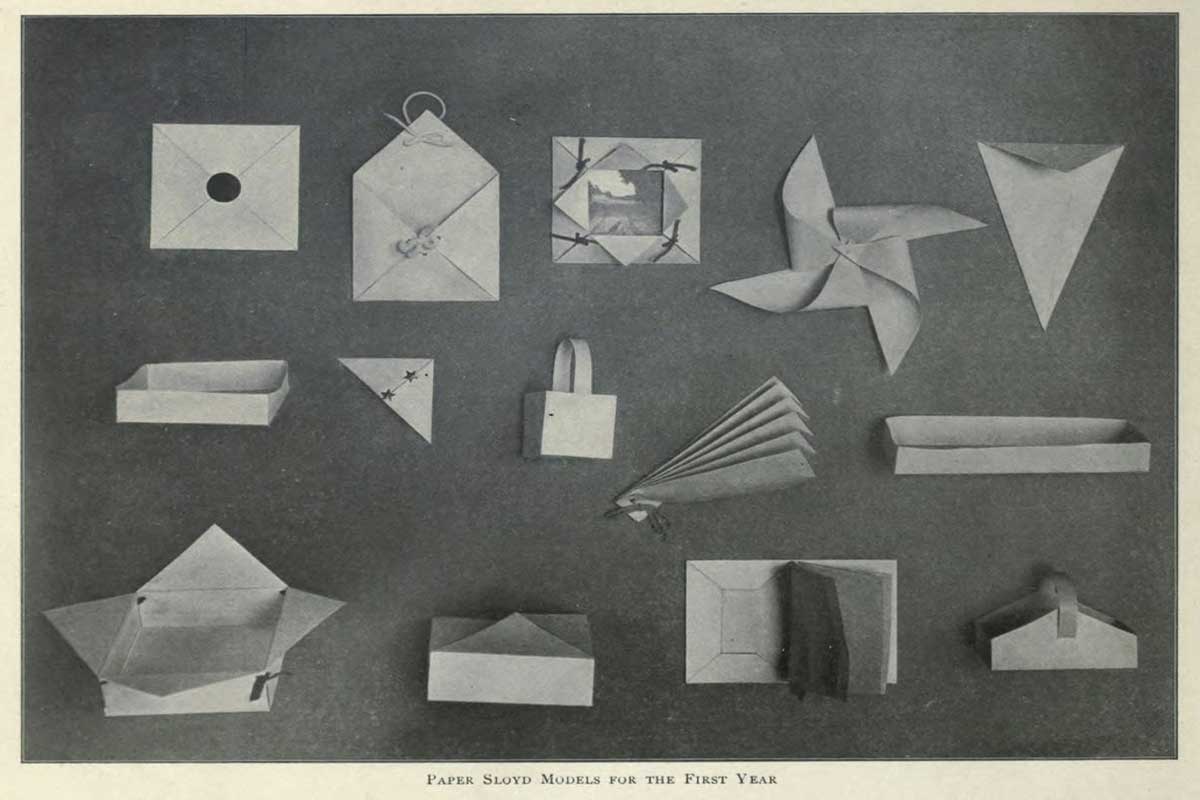

What is paper sloyd? The preface to Paper Sloyd: A Handbook for Primary Grades by Ednah Anne Rich defines sloyd as “tool work so arranged and employed as to stimulate and promote vigorous, intelligent self-activity for a purpose, which the worker recognizes as good.”
Note: This post was originally published on June 6, 2011 and extensively updated on June 17, 2025.
Sloyd, which means “skilled labor” in Swedish, was originally a system of training focusing on woodworking and its associated tools. The idea for this book is to build manual dexterity or hand-to-eye training in the early grades.
Paper sloyd regarded as a subject in itself — not as “busy work” — should have a place in the course of study with clay modeling, free-hand drawing, and brush work.
In the case of paper sloyd, the focus is on creating useful objects with paper. The tools are things the homeschool handy-mom is likely to have on hand — pencils, rulers, scissors, glue, string, compasses, and hole punches. An equipment and material list is provided.
One material note: There are various types of paper mentioned. Explanations are located in the materials list. A simple search at an arts and crafts store should help with almost everything. You can always substitute a modern alternative.
The book presupposes little or no knowledge of construction work and no experience in teaching the same; hence the information as to materials, equipment, etc., the explanation of the several operations in construction, suggestions as to methods of presentation, and the careful working directions or dictations are most explicit.
How to Use the Book
Although it is quite easy to work though Paper Sloyd at your own pace, it was designed to be completed in three years. The projects are divided up accordingly with lessons expected to take between 20–40 minutes, depending on the year.
Very detailed preliminary instructions are given in the “Working Directions.” There are important pointers on how to make clean folds and draw accurate lines, hold a ruler or position a pencil, and properly use a pencil compass.
The projects also have detailed instructions for making a variety of models, including:
- Envelopes and book covers the first year.
- Comb holders and pen boxes the second year.
- Flower holders and match boxes the third year.
A fourth chapter includes a variety of supplementary models.
Each project is accompanied by directions and a diagram showing where to fold and cut.
The teacher must be patient during the first part of the year and realize that manual work is brain work as well, and that the hand and eye must become used to giving quick response to the directions of the mind.
Whether you’re looking for rainy-day projects or an alternative to traditional origami, or maybe even a hands-on way to introduce basic math skills such as working with fractions, you’ll find many useful and interesting ideas in Paper Sloyd.
And the best part is that it’s available free online!
Free eBook
Keep Reading

Printable Paper ~ Featured Site
Over 1000 downloadable and printable paper formats for various uses ~ all for free.

Summer Fun Activity: Build Paper Boats
Besides being just plain fun, learn a little math, practice arts and crafts skills, and enjoy races and water fun while building paper boats.

Fold & Fly Paper Airplane Designs ~ Summer Fun Activity
Here is a great summer fun activity to keep hands busy: experimenting with these free 47 paper airplane designs!