
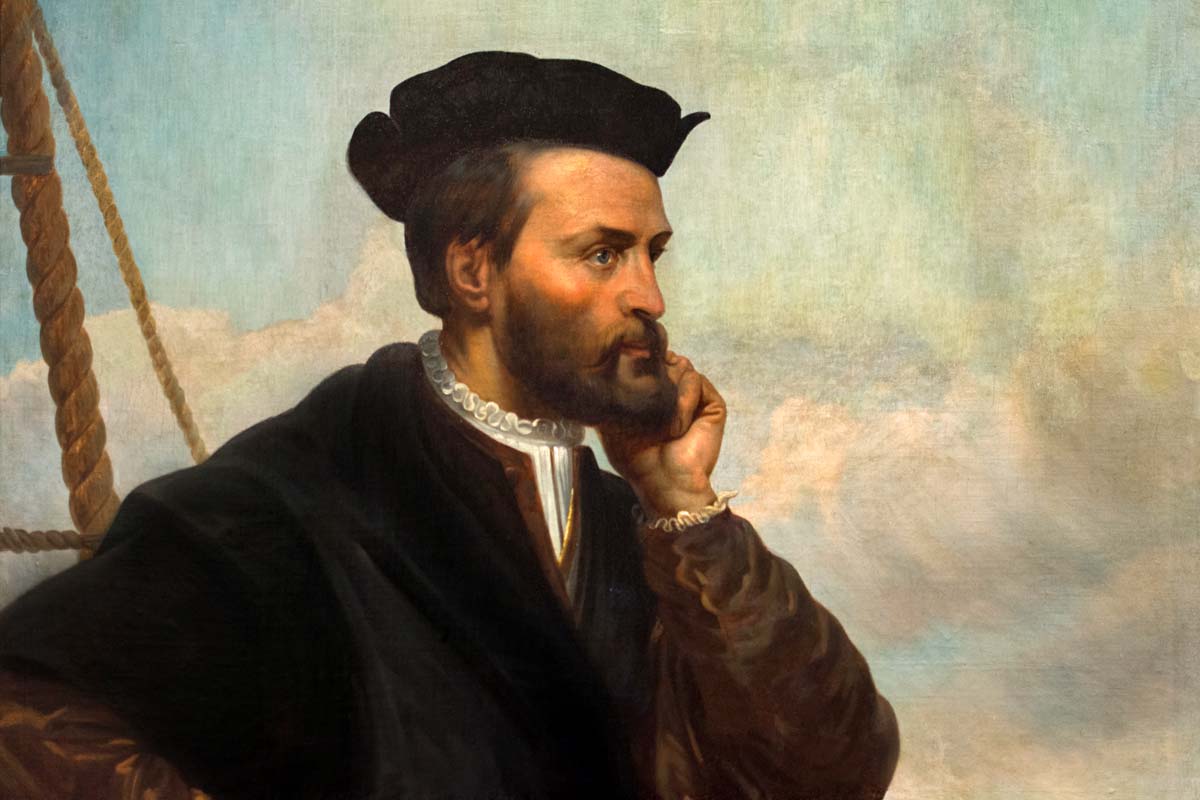

Jacques Cartier was born in 1491. He discovered the St. Lawrence River on June 9, 1535.
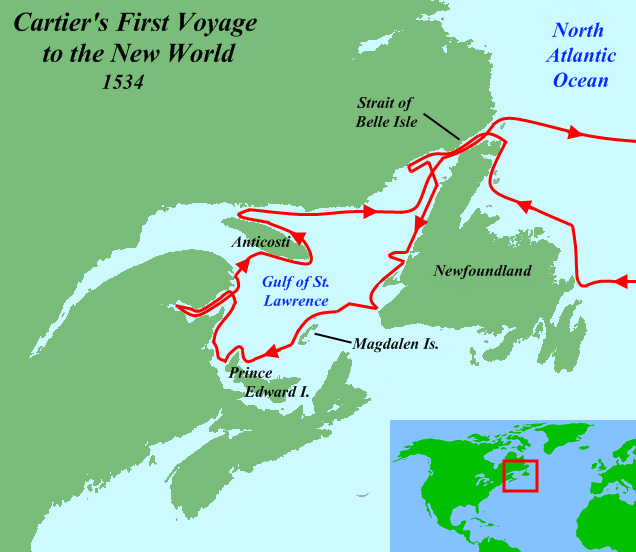
Cartier’s First Voyage
As he was considered a good seaman, in 1534 the king of France sent him to find a route from France to the western sea. On the first try, he found the inlet to the St. Lawrence, but didn’t enter it. Instead he returned home with a report that he might have found the passage sought after.
Cartier’s Second Voyage
The following year, being commissioned again to find the route aforementioned, he boldly returned and entered the St. Lawrence River and thus became the first European to discover it. Since the day he discovered the river was a feast day of St. Lawrence, Cartier gave the river St. Lawrence’s name, which it has borne to this day.
Upon sailing the St. Lawrence, he heard tales of kingdoms located on the river. Interested in seeing them, and also probably hopeful of finding gold, he journeyed on. On his way up the river, however, he soon discovered his way blocked by rapids, and decided upon wintering in Quebec.
His wintering didn’t go so well, as the party suffered from the dread of sailors — scurvy. To make matters worse, the party was lacking adequate clothing for a harsh winter such as is found in Canada. By the time the winter had ended, twenty-five men were lost and Cartier decided to head home.
He compelled three Indian chiefs and eight Indian warriors who had been hospitable to him to return to France with him. The majority died of unknown causes shortly after arriving in France.
Cartier’s Third Voyage

Cartier returned to the St. Lawrence six years later. After anchoring three of his five ships, he sent the other two back to France to ask for supplies. Meanwhile Cartier busied himself with trying to pass the rapids that had halted him before, but failed.
So he spent another winter on the St. Lawrence river. This party fared the winter better, but it was exceedingly cold for those accustomed to France’s warm climate. Once the winter ended, Cartier spent the following summer hunting for gold in the area (something most early explorers dreamed of finding), with but little success. He did discover a few diamonds, and named the location where they were discovered Cape Diamond, which name it has retained.
The following hard winter disheartened Cartier. The supplies he had asked for never arrived. He returned home, where he died in 1557 of failing health.
Cartier’s Contributions
Despite his rather discouraging voyages, Cartier accomplished two things: one, he established France’s claim to Canada; and two, he is credited with having discovered the St. Lawrence River.
Suggestions
Have your students do one or more of the following (helpful resources below):
- Chart all three of the voyages on a map.
- Create a timeline of Cartier’s life.
- Choose one of the voyages and report the event as though you were there.
Further Investigation
Jacques Cartier: Fast Facts
Helpful video from the History Channel.
(You may want to install an ad blocker before viewing.)
The Explorers: Jacques Cartier 1534-1542
Biography and interactive maps showing the routes he took from the Canadian Museum of Civilization.
Jacques Cartier
Biography from the Mariner’s Museum.
Jacques Cartier Sailed Up the St. Lawrence River (archived)
Simple history for young people from the Library of Congress.
Cartier (archived)
More detailed history from ThinkQuest.
Jacques Cartier’s Second Voyage to the St. Lawrence River and Interior of “Canada,” 1535-1536
Excerpts from his journal at NationalHumanitiesCenter.org.
St. Lawrence River
About the river.
Activities
Jacques Cartier
Interactive map from The Mariners’ Museum.
Find Your Longitude
Every good sailor needs to known where he is! Interactive from NOVA.
Activities for Students and Teachers
Twelve explorer activities including creating a compass, astrolabe, quadrant and globe; identifying instruments and parts of a ship; worksheets and more from the Mariner’s Museum (scroll down to Printable Activities).
Books

“Jacques Cartier Explores Canada”
Chapter from A Book of Discovery by M.B. Synge — a family favorite! For older students. Also available as a public domain download.
“The French in Canada”
Chapter from The Story of the Thirteen Colonies by H.A. Guerber.
Units & Lesson Plans

McGee, Thomas D’Arcy: “Jacques Cartier”
Poetry study from our Online Poetry Anthology.
Printables & Notebooking Pages

History Pockets: Explorers of North America
This Evan-Moor title is aimed at Grades 4–6 and covers Cartier. Great for notebooking!
Cartier’s First Voyage
Map for notebook.
The Second Voyage
Map for notebook.
The Third Voyage
Map for notebook.
Cartier Boat Graphic (.doc)
Cute graphic with basic facts. Since this document can be edited, you can erase the information, perhaps provide a few lines, and have the student fill out the information.
Jacques Cartier Notebooking Pages
Simple notebooking pages for copywork, narrations, or wrapping up.
These units have been created specifically with do-it-yourself (DIY) homeschoolers in mind: those that don’t want a lot of hand-holding. If this doesn’t describe your need, you might prefer a few of these pre-planned units. For those brave souls who enjoy pulling things together themselves, there are many ways to use these resources!
Keep Reading

La Salle and the Great Lakes: A Unit Study
Great Lakes unit study. On March 19, 1687, Robert La Salle died in Texas.

Free History Studies: Jacques Marquette
Jacques Marquette (also known as Père Marquette) was one of the first Europeans to travel down the Mississippi. Free history unit.


A Book of American Explorers ~ Free eBook
A Book of American Explorers is a free eBook that covers the Northmen in 985 through the Massachusetts Bay Colony in the early 1600s.