
On the evening of May 25, 1955, an F5 tornado touched the ground near the Kansas-Oklahoma state line. As it proceeded northward, it took a northeast twist that put it on a direct collision course with the small Kansas town of Udall. Let’s take a look at tornadoes: how they form, why they are so deadly, and how to stay safe.
The Udall Tornado
Udall had been under a tornado watch that evening, but as residents watched the 10 o’clock news they were informed that the danger was past. They did not know that a bureaucratic problem delayed the announcement of a warning until 10:08 PM—after they had switched off their television sets and started to prepare for bed.

A roar of wind roused the town minutes later, but it was already too late. People fled from their houses to take refuge in underground storm shelters only to find themselves in the path of the cyclone. The violent funnel plowed through town, killing 80 people and injuring over 200, half of the town’s population.
The Udall event set a record for the deadliest tornado in Kansas, and the 25th deadliest in the United States.
Where Do You Find Them
Little wonder that the tornado was long the most feared of weather phenomena. Even to this day, there are many details about them that scientists do not understand.
Tornadoes are not unique to the United States. They occur regularly in Great Britain, Bangladesh, parts of southern Russia, the border between Argentina and Brazil, northeastern Mexico, and the Canadian Prairie Provinces. America does seem to have the distinction of producing the most, however.
A tornado can occur in any state, but Tornado Alley in the center of the country is notorious for tornado activity.
How They Form

Most tornadoes are associated with supercells, powerful rotating thunderstorms. Not all supercells produce funnel clouds—many are characterized by frequent lightning, damaging winds, large hail, and flash floods. To spawn a tornado, a supercell must have both instability and large-scale rotation to work with.
Before one can form, there must be a strong vertical wind shear within the storm, producing a rotating cylinder of air. When the conditions are right for tornado creation, this cylinder rotates at increasing speeds and stretches out. At the moment that one end of the cylinder touches the ground, it becomes a tornado.
Tornado Movement
The behavior of a tornado tends to be extremely irregular. For example, it may:
- Bulldoze across the countryside for hours.
- Promptly withdraw into the clouds without causing the slightest damage.
- Climb mountains, descend into valleys, or persist in a straightforward course across level terrain.
- Whip an unstable structure into shrapnel while leaving a sturdier building next door almost unscathed.
- Drive splinters through iron, and sweep checks and letters into other states.
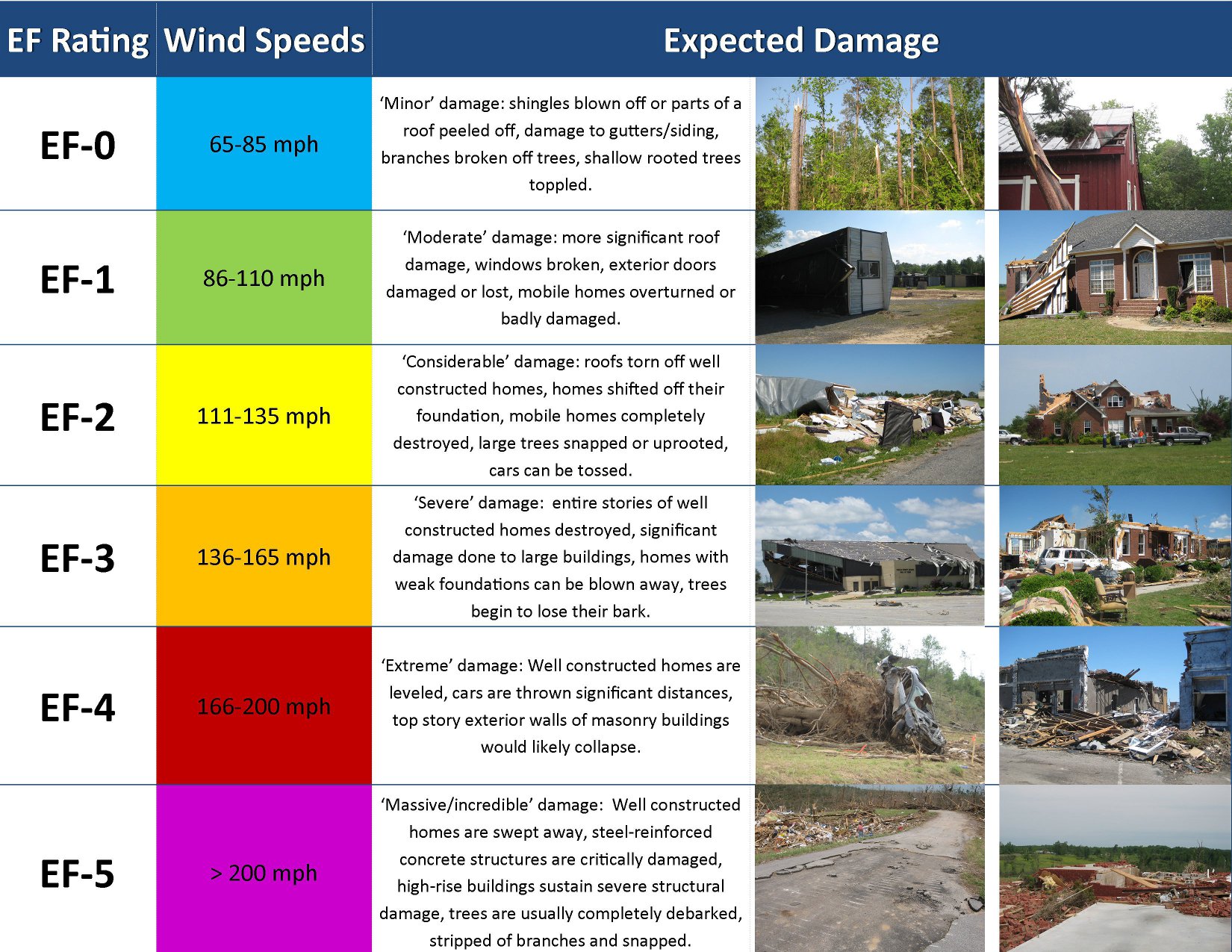
After it has passed, the damage it has left behind can be used to form a subjective estimate of its strength. The EF-Scale, originally invented by Dr. T. Theodore Fujita in the early 1970s and improved in 2007, is used in this process. EF-0 is the low end of the scale, with little damage and gusts of 65 to 85 mph. EF-5, characterized by total destruction and gusts over 200 mph, is the high end.
Safety
Fortunately, there are safety precautions that you can take when severe weather hits:
- Pay attention to forecasts, watches, and warnings. There are many ways to keep track of current conditions, including the Internet, smartphone apps, weather radio, and local radio and television stations.
- If a tornado watch is issued, stay close to shelter and make sure that your family and friends are aware of the potential threat.
- If a tornado warning is issued, take shelter immediately.
- Take shelter on the lowest level of a house or building. If you have no basement, choose an interior room. Stay out from under heavy furniture and appliances on the floor above. If you can, protect yourself underneath a workbench or mattress.
- If you are in a car, drive at right angles to a tornado if possible. If you don’t have time to escape, pull over, get out of the car, and run for a sturdy building (preferably) or lie flat in a low spot away from the road. Never try to take shelter under a bridge.
Tornado Facts
- Most tornadoes in America occur between April and June.
- The earliest date on which a tornado has occurred in any year is January 1. The record was set in 2011 when a funnel cloud touched down in Attala County, Mississippi only two minutes into the new year.
- Most tornadoes in the Northern Hemisphere rotate counterclockwise, but there have been exceptions. A small minority rotate clockwise.
- The largest known funnel cloud touched down near El Reno, Oklahoma, on May 31, 2013. It had multiple vortexes, enabling it to cover over 2 ½ miles at its widest.
- Oklahoma City has been hit by more tornadoes than any other United States city, with 160 recorded between 1890 and 2015.
- Almost 60 people on average are killed by tornadoes annually.
- The deadliest and costliest tornado in modern times hit Joplin, Missouri, on May 2, 2011. It caused 158 deaths and about $2.8 billion in damage.
- The deadliest year in modern history was 2011, with 550 people killed across 15 states.
- The first documented successful tornado forecast by meteorologists was on March 25, 1948, by Air Force Captain (later Colonel) Robert Miller and Major Ernest Fawbush.
- Until 1950, use of the word tornado in forecasting was prohibited or strongly discouraged to avoid panic.
Suggestions
- Explain the different tornado alerts.
- Highlight “tornado alley” on a map of the United States.
- Narrate how a tornado forms.
- Create a flip book for the EF-Scale.
- Create a how-to essay explaining how to stay safe in a tornado.
Further Research
Udall 1955
Brief description of the worst tornado in Kansas history.
Info on the Udall Kanansas Tornado
Background from NOAA.
Pictures from the Udall Event
From NOAA.
Twister Dashboard
Statistics and locations of tornadoes from Smithsonian Magazine.
Facts
Basic facts for kids at WeatherWizKids.com.
Tornado Basics
Facts from NOAA.
How Tornadoes Form
Simple explanation at National Geographic for Kids.
FAQs
Extensive guide on tornadoes at NOAA.
Types of Tornadoes
The difference between supercell and non-supercell tornadoes from NOAA.
Enhanced F Scale for Damage
Extensive description of the enhanced Fujita tornado scale.
Safety
What to do to stay safe from the Department of Homeland Security.
Activities
How Do Tornadoes Form
TED-Ed video. (You may want to install an ad blocker before viewing.)
Tornado Simulator
Experiment with tornado speed and size to determine EF-scale value.

Discovery Lab
Create your own … with sound.
Vortex
Same idea as above but more complicated from the Exploratorium.
Write the Conclusion: When a Tornado is Coming
Simple printable from K12Reader.com where students read basic facts and write a conclusion. Good for wrapping up.
Books
Tornado Book
Free 40-page comic book from the South Dakota Office of Emergency Management.

Tornado Alert by Franklyn M. Branley
Part of the Let’s-Read-and-Find-Out Science series, perfect introduction for younger students including the science behind tornadoes and tornado safety, all from a favorite author!

Tornadoes! by Gail Gibbons
From another favorite author, this one goes into more historical detail, and covers how tornadoes form and the Fujita scale.

Tree in the Trail by Holling C. Holling
Beautifully illustrated title on our recommended reading list with a tornado element. Read our full review with suggested activities.

Kansas: In the Heart of Tornado Alley by Dr. Jay M. Price
Finally, for more mature readers interested in the Udall tornado and others like it in Kansas, this photo narrative by a Wichita State University professor and his students describes the effects of the destruction and the rebirth in the rebuilding with the intention to “show the varied ways in which the tornado has shaped the lives of Kansans.”
Unit Studies & Lesson Plans
Safety Activity Book
16-page download for younger students with coloring pages.
Owlie Skywarn Weather Book
Another activity book from FEMA, NOAA, and others.
Tornado! Lesson Plan
Great lesson plan from the University of Colorado that explores the Fujita scale and tornado-proof buildings.
Tornado Alley
K–12 Educator’s Guide loaded with scientific information, safety information, experiments, and recommended resources.
Notebooking Pages & Printables
Tornado Activity in the United States
Map of tornado alley.
Inside a Tornado
Infographic from National Geographic.
Tornado Guide (archived)
Another great printable infographic.
Family Communication Plan
Preparedness printable from FEMA.
Safety Checklist
From the Red Cross.
Adjectives Describing a Twister
Printable shape page at EnchantedLearning.com.
EF-Scale
For notebook or flip-book mentioned in suggestions.
Shape Poem
Or create a tornado poem to wrap up (also at EnchantedLearning.com).
These units have been created specifically with do-it-yourself (DIY) homeschoolers in mind: those that don’t want a lot of hand-holding. If this doesn’t describe your need, you might prefer a few of these pre-planned units. For those brave souls who enjoy pulling things together themselves, there are many ways to use these resources!
Keep Reading

Hail: A Unit Study
During a thunderstorm on September 3, 1970, hail formed, creating the heaviest hailstone of the 20th century. Unit resources.

Kansas: A Unit Study
On January 29, 1861, Kansas became the 34th state in the Union. Unit resources.