

Up to June 30, 1834, Andrew Jackson had aggressively enforced the Indian Removal Act of 1830, which sent the Five Civilized Tribes of the South (Cherokee, Chickasaw, Choctaw, Creek, and Seminole) west of the Mississippi. He claimed that it was for their own good, that they could not live with the white men and prosper. Any time the two races came into contact, wars and suffering were the result. But on June 30, Congress remedied the situation with the Indian Intercourse Act.
The Trail of Tears
The Indian Intercourse Act designated all of the land west of the Mississippi as Indian country except for Missouri, Arkansas, and Louisiana. However, its main purpose was not to establish the boundaries of Indian Territory, which were rather vague and frequently changing. Its main purpose was to regulate the interactions of the tribes with each other and with the United States.
White men were strictly forbidden to hunt, trap, settle, or graze cattle in Indian Territory. Those who were engaged in trade had to be licensed and could not deal in liquor.
Once Indian Territory was created to keep the two races separate, Jackson decided that it was time to drive the Indians still living among the whites out onto the Trail of Tears.
The History of Indian Removal
The idea of moving the Indians to more “convenient” locations was not new.
As early as 1804 Thomas Jefferson was given the authority to negotiate the removal of the Indians to the area included in the Louisiana Purchase. Between 1816 and 1830, the Cherokees, Choctaws, and Creeks signed many treaties exchanging their land in the South for homes further west.
But when the Indian Removal Act was passed, the Five Civilized Tribes began moving into Oklahoma in large numbers. Other tribes, such as the Seneca, Shawnee, Delaware, Cheyenne, and Apache, were also signing treaties that would take them into Indian Territory.
Only the Seminoles dared to resist the change being forced on them.
The Moving Boundary
But not even the Indian Intercourse Act could keep the white man out of Indian Territory. White men were always hungry for more land. Kansas and Nebraska were soon removed from Indian Territory in 1854.
Next came the Civil War. The Indians fought on both sides of the struggle, but the fact that many members of the Five Civilized Tribes had been Confederates meant that penalties were in store.
In a treaty signed in 1866, the Five Civilized Tribes gave up all of their remaining land in Kansas, plus the western half of present-day Oklahoma. The lands in the western part of Oklahoma were set aside for what the government termed “friendly Indians.” Western tribes displaced by Westward Expansion received this area, but also to Indians that had still been residing in Kansas.
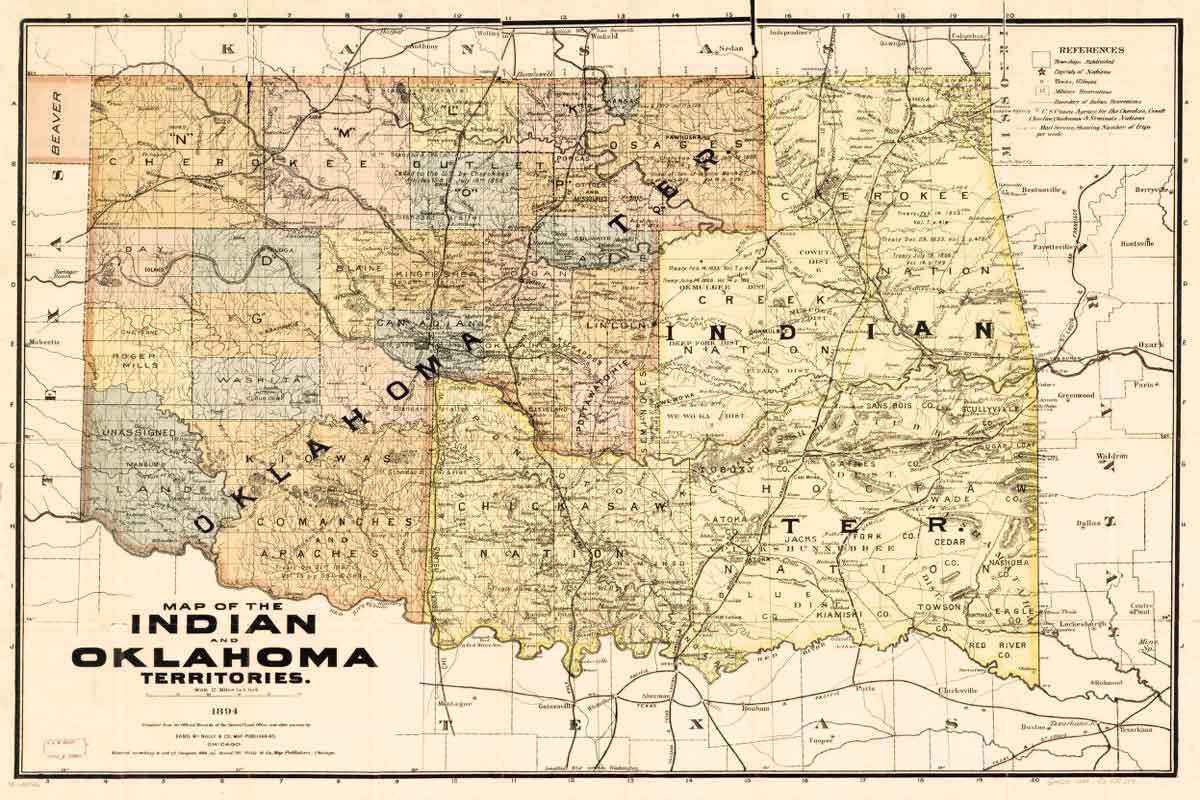
Indian Territory
In spite of the large numbers of Indians being moved into Indian Territory, a great deal of unassigned land remained. Indians leased the land as pasture for cattle. White settlers and railroad officials had their eyes on it.
The government opened the unassigned lands. On April 22, 1889, the whites came flooding in. The following year, they created the Territory of Oklahoma. Indian Territory was reduced to only the eastern half of the area.
Indian Citizens
By this time, the outcome was obvious. The government set to work abolishing tribal systems and making the Indians U.S. citizens.
The Indians tried to keep some control of their territory by pushing for its admission to the Union as the State of Sequoyah. However, their request was denied. Oklahoma Territory and Indian Territory became the State of Oklahoma on November 16, 1907.
In spite of all the promises made throughout the years, Indian Territory was no more.
Further Investigation
From Horseshoe Bend to the Trail of Tears (archived)
President Jackson and the Trail of Tears for younger students from the Library of Congress for Kids site.
Indian Removal
Great background information from Digital History at the University of Houston. (Use the navigation links at the top to view the entire timeline.)
Indian Removal Timeline
Brief chronological look at events.
Brief History of the Trail of Tears (archived)
Written from the Cherokee perspective.
North American Indians (archived)
ThinkQuest with basic information for younger students.
Culture Areas and the Locations of Tribes with Illustrated Clothing
American Indians by region.
Activities
Learning Another Language
Activity using Sequoyah’s language.
Native American Burlap Weaving
Lesson from DickBlick.com.
Native American Recipes
Cook a dish!
Books

North American Indians by Douglas Gorsline
Good illustrated introduction to the various North American Indian tribes.
Unit Studies & Lesson Plans
Cherokee People: Elementary Lesson Plan
From NPS with colorful downloadable activities.
Oklahoma Indian Country
Great guide to the various Indian tribes with workbook, research, and map questions at the end. You’ll want the Teacher’s Guide for answers.
The Trail of Tears
Extensive lesson plan from the National Park Service.
Cherokee Removal and the Trail of Tears
Teaching Guide @ the Digital Public Library of America.
Notebooking Pages & Printables
Indian Territory
Map of the Indian Territory set aside by the Indian Removal Act.

Map of the Plains Indians (archived)
Great map for notebook that shows all of the North American Indian tribes.
American Indians and Alaska Natives in the United States
Census map of current populations for notebook.
Indian Territory Notebooking Pages
Simple pages for copywork, narrations, or wrapping up.
These units have been created specifically with do-it-yourself (DIY) homeschoolers in mind: those that don’t want a lot of hand-holding. If this doesn’t describe your need, you might prefer a few of these pre-planned units. For those brave souls who enjoy pulling things together themselves, there are many ways to use these resources!
Ready for More?
