


Soil. It’s easy to take for granted. After all, it’s always there, right below our feet. But soil is actually a complex ecosystem, a place where geology, chemistry, and biology (along with a few other sciences) meet.
The result of this interaction is more than simply a solid surface upon which to stand, as important as that is. Soil can be used to produce a wide range of useful items, from pigments to construction materials.
But more than that, soil is essential for life. Soil is the world in which plant roots live. And these roots in turn grow the grains, vegetables, fruits, and other crops that feed both animals and humans.
What is Soil?
The average healthy soil consists of four primary components:
- Minerals (45% of the total volume on average).
- Atmosphere (25%).
- Water (25%).
- Organic matter (5%).
The mineral component is often the most conspicuous part of the soil. It is derived from the rock lying just below the surface, known as the parent material. This rock slowly but steadily decomposes with the assistance of water and various naturally occurring acids. Different places have different types of native rock, which is why soils vary so dramatically from one place to the next.
The atmosphere, or air, component fills in empty spaces between the mineral particles. In the soil, the atmosphere tends to contain large amounts of carbon dioxide, a portion of which is released from plant roots, particularly those of grasses.
The water component also occupies the spaces between the mineral particles. This portion is particularly important to plant roots, as it not only hydrates plants but supplies minerals in solution so that plants can use them.
Organic matter is the portion of the soil that is derived from living things. Decayed plant roots make up a great deal of the stable organic matter in the soil. However, there may also be other plant pieces along with various animal wastes and the remains of invertebrates and even larger animals. Organic matter is an important part of soil because it serves as food for a variety of organisms and because it acts as a sponge for moisture and nutrients.
Soil Textures
A very important aspect of soil is its texture, which refers to the size of the mineral particles. Different types of parent rock and different stages of rock decomposition produce particles of different sizes. Soil particles are classified as follows:
- Sand: Particles ranging in size from 0.05 mm up to 2 mm.
- Silt: Particles ranging from 0.002 mm to 0.05 mm.
- Clay: Particles less than 0.002 mm in size.
The reason the size of the particles matters is that it affects the amount of air and water that can pass through the soil. Coarser particles stick together loosely, leaving large spaces for air and water to pass through, while finer particles offer less space. During a heavy rain, water soaks into a sandy soil more easily than a clayey one, but it runs out more quickly, too.
Most soils contain some combination of particle sizes. Depending on the types and percentages of the various particles, a soil might be classified as a silty clay or a sandy clay for instance. The soils regarded as offering the most ideal mix of particle sizes for plant growth, those that offer a balance between moisture retention and drainage, are classified as loam. Loam soils are primarily silt-based, but they also include varying amounts of sand and/or clay.
Soil Minerals
When water filters between the particles of mineral and organic matter in the soil, it absorbs a variety of nutrients useful to plant life. Three nutrients are typically regarded as being the most important because plants require relatively large quantities of them for a substantial yield of grain or produce:
- Nitrogen (N). Required for rapid plant growth, as it is used for building leaves and stems.
- Phosphorus (P). Necessary for fruit development and ripening.
- Potassium (K). Used for building cellulose (the main constituent of plant cell walls) and especially favored by root crops.
However, for healthy growth, plants also rely on a wide range of other elements, albeit in smaller quantities:
- Aluminum.
- Boron.
- Calcium.
- Chlorine.
- Cobalt.
- Copper.
- Iron.
- Magnesium.
- Manganese.
- Molybdenum.
- Nickel.
- Selenium.
- Sulfur.
- Zinc.
And there are very likely other elements used, the functions of which we do not yet understand.
Different soils contain varying amounts of these elements, depending on the parent material and on the types of organic matter present. Some soils do not contain enough of one or more key nutrients to sustain plants, while smaller deficiencies can cause nutrient deficiencies in the animals and people who rely on the plants for food. In some cases, pollution and other forms of contamination can lead to a buildup of excess nutrients, which can be toxic for plants, animals, and people alike.
Soil & pH
Even though a particular element may be present in the soil, it may or may not actually be available for uptake by plant roots. For one thing, roots can only absorb minerals in solution, which means that moisture must be present in the soil. For another thing, the pH of the soil is also important.
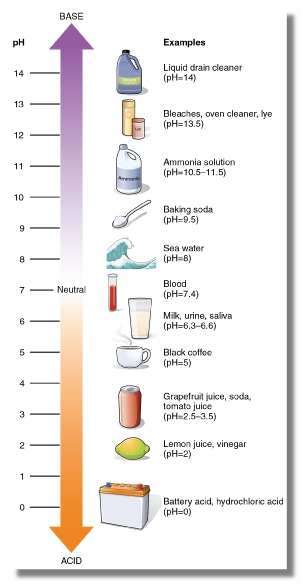
The pH scale is a method of describing the quantity of hydrogen ions in a particular soil.
- Neutral or having a pH of 7.0 if it contains equal amounts of positively charged hydrogen (H) ions and negatively charged hydroxide (OH) ions.
- Acidic or having more H ions and a pH below 7.0.
- Alkaline or more OH ions and a pH above 7.0.
Some of the plant nutrients listed above bind more readily to the positive H ions, while others bind more readily to the negative OH ions. A tightly bound element may become locked into place; even when moisture is present in the soil, certain nutrients may not dissolve into the solution, thus making them unavailable for plants to use.
Different plants have different pH preferences. The vast majority of plants important for food use thrive best on the type and quantity of nutrients available when the pH is in the 6.5 (mildly acidic) to 7.0 (neutral) range, although many plants can tolerate a pH slightly outside of this range.
Life in the Soil
Perhaps one of the most surprising aspects of soil is the wide array of life forms that it is home to. A wide range of digging, tunneling, and burrowing animals call the soil home, ranging from snakes to moles. Many insects spend all or part of their life cycles underground, including ants, cicadas, beetles, and others.
One of the most familiar soil residents is the hardworking earthworm. The earthworm is appreciated by many gardeners for its role in digging tunnels that aerate the soil and in expelling castings high in a number of nutrients. These castings are produced as the worm consumes soil in search of organic matter to eat. The soil passes through the worm’s gizzard, where the particles are ground finely, and then the indigestible portion is expelled, coated in the worm’s own biologically rich secretions.
But the majority of the soil residents are much less visible. These species include nematodes (tiny worms), protozoa, bacteria, fungi, and algae. Some species can be harmful to plants, animals, or humans, but most are not. In healthy soil, many of them form complex partnerships with each other and with any plant roots that have crept into their domain, exchanging nutrients and warding off diseases, among other things.
Caring for the Soil
Because healthy soil is necessary to support healthy plants, keeping the soil in good condition is one of the most important tasks of gardening.
An excellent starting point is to preserve space between soil particles for air and water to fill. Avoid walking on vegetable or flower beds, as this compacts or presses the particles together. If your soil is compacted already, loosening it with a fork or broadfork (a large U-shaped tool with two handles and a bar with tines) is a better option in most cases than using a rototiller. This is because the rototiller turns the topsoil upside down, disrupting the soil organisms that work with your plant roots, and it also compacts the soil at the furthest reach of the blades.
Sometimes soil nutrients and pH require adjustment. To determine if this is the case in your garden, you can use a home soil test kit, which will tell you about the NPK and pH of your soil and will provide instructions for what to do if something is wrong.
Making compost is a way to both boost soil nutrient levels and provide extra food for soil life, including earthworms, as well as an interesting science experiment. Composting is the process of speeding up the decomposition of organic materials to make your own plant food. There are many different recipes for compost, some using heat to kill harmful bacteria and to produce compost more quickly, and others keeping the ingredients cooler to retain additional nutrients. One suggestion is to try several different methods and compare the results.
Building Healthy Soil
If you are really curious about experimenting with ways to build healthy soil, you can try cover cropping in your garden. Cover cropping is a practice used by some farmers to increase the levels of organic matter in the soil. Cover cropping involves establishing a thick growth of plants that will not be harvested, but will be turned under to feed the soil life. Many different types of cover crops are used depending on the time of year, the needs of the soil, and how quickly the plot will be needed to produce food again, but grains, legumes, and plants with thick taproots are commonly used.
As you learn more about soil, you will undoubtedly find out about other ways to make it a healthy place for both plant roots and various microorganisms to thrive. More important than any particular technique or method is to keep in mind the interaction between the soil’s structural components, its residents, and plant roots. It is this interaction that makes soil a complete ecosystem in itself.
Suggestions
Ask your students to: (resources below will help)
- Make a flip book showing the primary components of soil (see above).
- Explain the different soil textures.
- Use Drawing & Writing paper to describe NPK and their relation to one another. Why is more not better in this case?
- Learn more about the various minerals in soil by exploring them on the Periodic Table of Elements.
- Go get messy. What type of live creatures does your soil contain?
- Learn more about earthworms.
- Grow something.
Further Investigation
Soil Basics
From the University of Maryland Extension.
Soil pH for Field Crops
Guide from HomesteadOnTheRange.com.
Activities
How to Test Soil Type
Do your own test!
State Soils
Click on your state for a free download from the Soil Science Society of America.
What is Soil?
Includes a quiz at the end for wrapping up.
Units and Lesson Plans
Soil pH Lab
From Purdue.
Printables and Notebooking Pages
Soil is Alive
Nice activity booklet from the USDA for Grades 3–7.
pH Scale
Illustration for notebook.
These units have been created specifically with do-it-yourself (DIY) homeschoolers in mind: those that don’t want a lot of hand-holding. If this doesn’t describe your need, you might prefer a few of these pre-planned units. For those brave souls who enjoy pulling things together themselves, there are many ways to use these resources!
Keep Reading

The Dust Bowl: A Unit Study
In May 1934, a severe dust storm hit the Great Plains, causing devastation. Unit resources.

Harry the Dirty Dog ~ Free Video & Activities
Children love reading about a dog they can totally relate to.

Free Nature Studies: How Plants Grow
Each part of a plant — root, stem, leaves, and flowers — has an important role to play. Unit resources.