

With phonics. But that doesn’t necessarily mean you have to drill phonograms! There is a more natural way to teach reading using phonics.
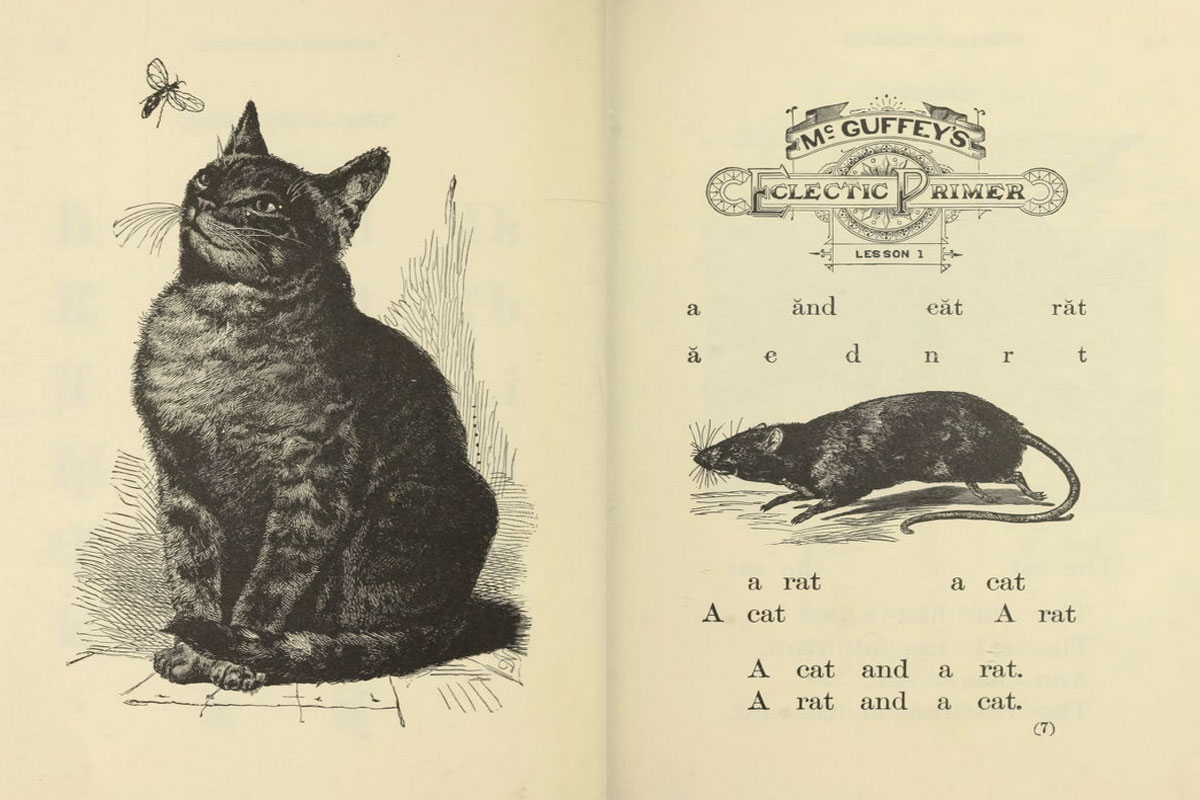
For this example, we’ll use McGuffey’s Primer. But you are encouraged to use what you already have on hand.
The Natural Path to Reading
First, brush up on the natural path to reading. The key takeaways are:
- Be patient.
- Don’t underestimate your own ability to tutor something you know (you ARE reading this…).
- Remember, there is no magic bullet. Patience will go a long way.
- Keep lessons informal.
The Decoding Stage
Using The Original McGuffey’s series, you’ll begin the decoding stage of reading with the Primer (and subsequently, the Pictorial Primer). In those books you’ll teach phonics (and also handwriting and spelling).
When we learn the alphabet, we learn the letters. Now we want to learn the sounds that the letters make. Rather than overwhelm a child with all of the sounds at once, start with a few sounds that can be blended into words. Your child will be reading. That will be exciting!
There is an easy way to approach phonics. When I was teaching our first child to read it was so natural I almost missed it myself. I naturally said (when she got stuck) “igh makes the I sound.” That was enough. Simple.
If you still feel more help would be in order, try the Phonics Made Plain Wall Chart and Flashcards. These are published by Mott Media and were recommended by Ruth Beechick. As she indicated, if your new reader can learn the 50 most common phonograms, he is on his way to the information stage of reading.
The Phonics Made Plain cards will have a letter (or pairs) on one side and the information on the other. For example, show the letter a while explaining a can sound like a (short vowel sound like apple), ay (long vowel sound like made), and the ah sound like father.
The Phonics Made Plain cards are keyed to A B C and All Their Tricks. At one point in time, we had both. While I found the book a bit overkill, those who would like a refresher may appreciate it. (But if you insist your child learn everything in that book, you risk turning her off reading for some time!)
Blending
Ruth Beechick recommended starting with two vowels (a and e), and then adding a few consonants (b, c, h, m, n, p, r, t). With those letters (and their sounds) the student can begin to blend.
For example, c makes the k sound like cat (and the s sound like cent). If I add a and t I can blend c- a- t.
Encourage your child to work through one or two lessons each week. Don’t go too fast; go at the child’s pace. Some take to blending very easily, some will take more time — both are acceptable!
Keep it fun by adding variety vs. drill. Find objects around the house that use the sounds being studied. We had a colorful workbook that used stickers to reinforce what was learned. Another option is the online apps or interactives.
The Notebook
And finally, make a phonics notebook (or booklet) when your child can adequately use a pencil.
As you work through the lessons in the McGuffey Primer, you’ll want to include books from the shelf. An example would be The Little Red Hen.
There are many resources we can use to teach phonics. Any one of the ones you’ll find at our site (which of course, we consider some of the best) will do the job. The old saw is that the one that worked was the last one used.
It takes time. Be patient. He will learn to read.
Additional Resources
McGuffey Eclectic Primer (Revised Edition)
Free download.
McGuffey New First Eclectic Reader
This is essentially the same as The Pictorial Eclectic Primer in the 1836 series.
Reading-Literature: The Primer {Free eBook}
Includes a very helpful chart for learning phonics.
Reading Index
Includes many phonics resources.
Keep Reading

Alpha-Phonics Workbook ~ Free
Teaching reading at home is often overcomplicated. The key is patience and using a naturalistic teaching method. Alpha-Phonics Workbook is a free aid to…

How to Use Noah Webster’s Reading Handbook
Noah Webster’s Reading Handbook is an inexpensive option for those interested in a more natural method, but with lessons already laid out.

Activity: 12 Ways to Practice Phonograms
Practice phonograms with these 12 suggestions.