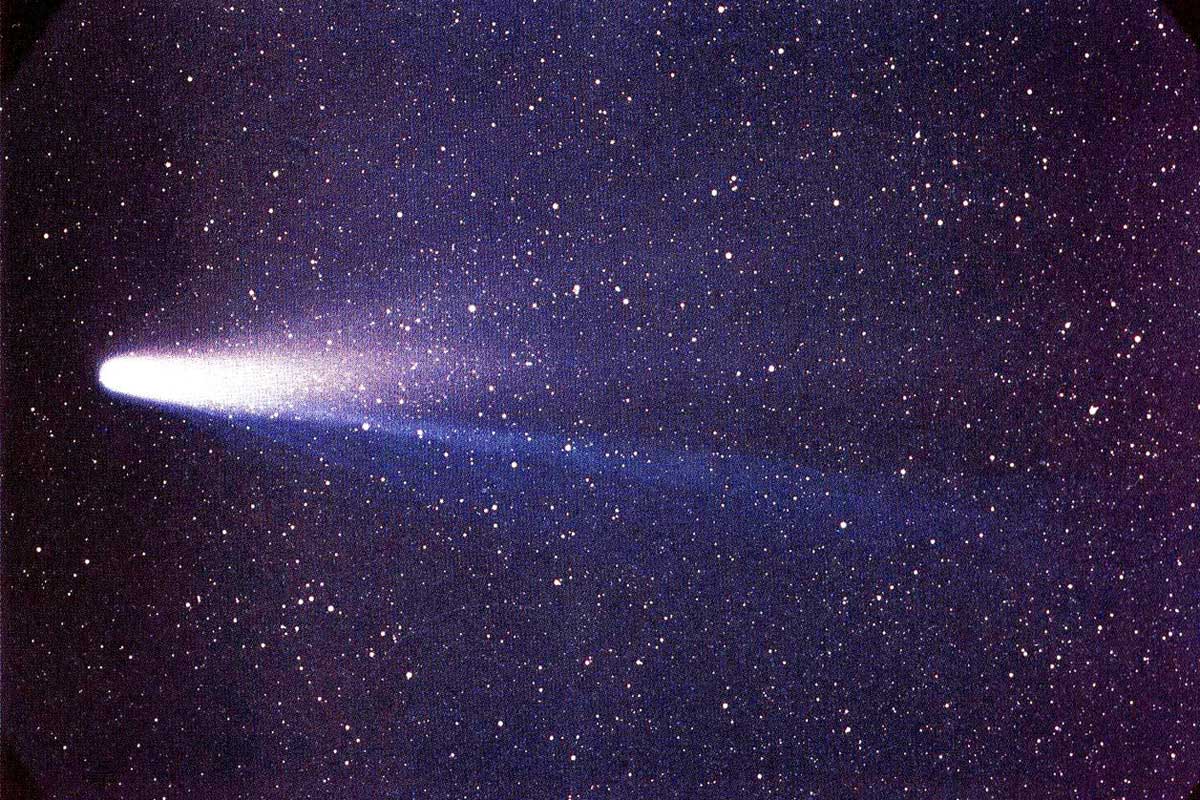

On May 19, 1910, Halley’s Comet produced quite a stir when the earth passed through the tail of the comet. To some, this was to be the end of all that breathed, killed by poisonous gas in the tail. Obviously, we survived the event.
Table of contents
What is a Comet?
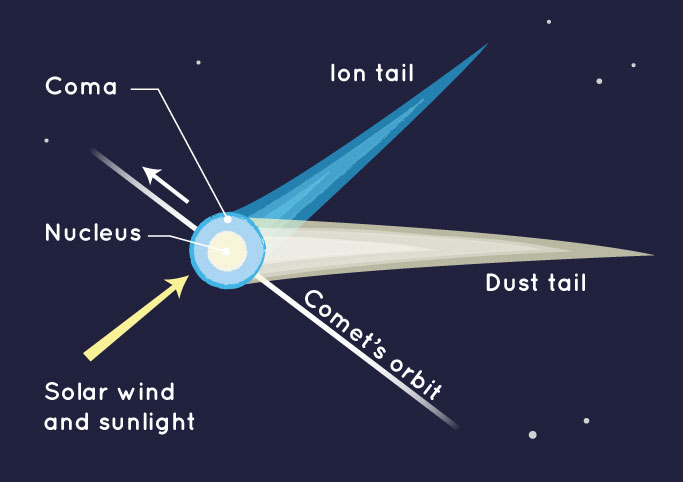
According to the latest theory on comets, comets aren’t always so spectacular, and they don’t always have that tail — at least, not right away. It is supposed that comets are “dirty snowballs,” containing regular ice mixed with hydrogen, nitrogen, carbon, and oxygen — all frozen. As the comet approaches the sun in its orbit, some of the frozen materials melt and fly off to form a tail.
These gases, which now compose the tail, absorb and then re-emit the sunlight, according to the resonant frequency of the molecules. As dust is also in this gaseous tail, the dust also reflects the sun. Hence, the bright visible tail.
When Will a Comet Appear?

Perhaps the most remarkable thing about Halley’s comet in particular is the fact that it is always known when its appearance will occur. Edmond Halley, whose name the comet bears, was the one to calculate when it would appear.
Using Newton’s laws of gravity, which were fairly new at the time, Halley calculated the effect of Saturn and Jupiter’s gravity on the comet. From there, he concluded that several comets that had been observed in previous years were actually one and the same. By calculating the effects of all the planets’ gravitational pulls on the comet, and also the time it took between appearances, Halley concluded that the comet would appear again in 1758, the last appearance having been in 1682.
Although Halley never lived to see it, his calculations were correct. After the 1758 appearance, the comet appeared again in 1835, 1910 (as already mentioned), 1986, and it should appear next in 2061 — a long time to wait!
Suggestions
Have your students do one or more of the following:
- Draw and illustrate a picture of a comet on Drawing & Writing paper.
- Label the drawing.
- After reading more about comets below, narrate everything you know about comets.
- Review Newton’s laws of motion.
Further Investigation
Comets and the Age of the Solar System
Primarily addressing the origins of comets and the age of the solar system, this article from Answers in Genesis also contains very useful background information on comets.
A Brief History of Halley’s Comet
Background from the History Channel.
Images of Comet Halley
From NASA.
Comets
Simple introduction at EnchantedLearning.com.
Some Major Comets
A look at Halley’s Comet and others at EnchantedLearning.com.
Activities
Interactive Comet
Interactive from the National Earth Science Teachers Association that helps students learn how comets work. (If Flash is a problem, use this link.)
Make a Comet
Rather complicated activity at ScienceKids.co.nz involving dry ice, but very helpful for understanding how a comet works!
Label the Diagram of a Comet
Interactive activity at EnchantedLearning.org.
Comet Prediction Worksheet
In this worksheet from the Center for Science Education at Berkeley, students use their math skills to predict the years a comet will be visible. Answer Key.
History and Exploration Worksheet
For review from the Center for Science Education at Berkeley. Answer Key.
Characteristics of a Comet Worksheet
For review from the Center for Science Education at Berkeley. Answer Key.
Comet Orbits Worksheet
For review from the Center for Science Education at Berkeley. Answer Key.
Books

The New Astronomy Book by Danny R. Faulkner
Covers the basics of astronomy, the moon, the night sky, stars, planets, galaxies, comets, and much more.
The Astronomy Book Study Guide
Unit Studies & Lesson Plans
Cool, Curious Comets
2-page activity sheet from NASA.
Comets vs. Asteroids
Another activity sheet from NASA.
Make a Comet Model and Eat It!
Students build a comet they can eat to demonstrate the makeup of a comet in this activity at NASA.
Comets Galore!
Simple lesson plan from Crayola.
Printables & Notebooking Pages
Comets Lithograph
Beautiful color image with comet information at NASA — perfect for notebook!
Comets
Coloring page for notebook from Enchanted Learning.
Structure of a Comet
Diagram for notebook at NASA.
Comets Notebooking Pages
Simple notebooking pages for copywork, narration, or wrapping up.
These units have been created specifically with do-it-yourself (DIY) homeschoolers in mind: those that don’t want a lot of hand-holding. If this doesn’t describe your need, you might prefer a few of these pre-planned units. For those brave souls who enjoy pulling things together themselves, there are many ways to use these resources!
Keep Reading

The Bayeux Tapestry: A Unit Study
On August 22, 1944, the Nazi SS made their attempt to capture the Bayeux Tapestry. Unit resources.

Starland {Free eBook}
December is a perfect month in which to look up at the stars! Starland by Sir Robert Stawell Ball makes a great guide.

Great Astronomers ~ Free eBook
Great Astronomers provides biographical sketches of 18 noted astronomers. Free eBook