
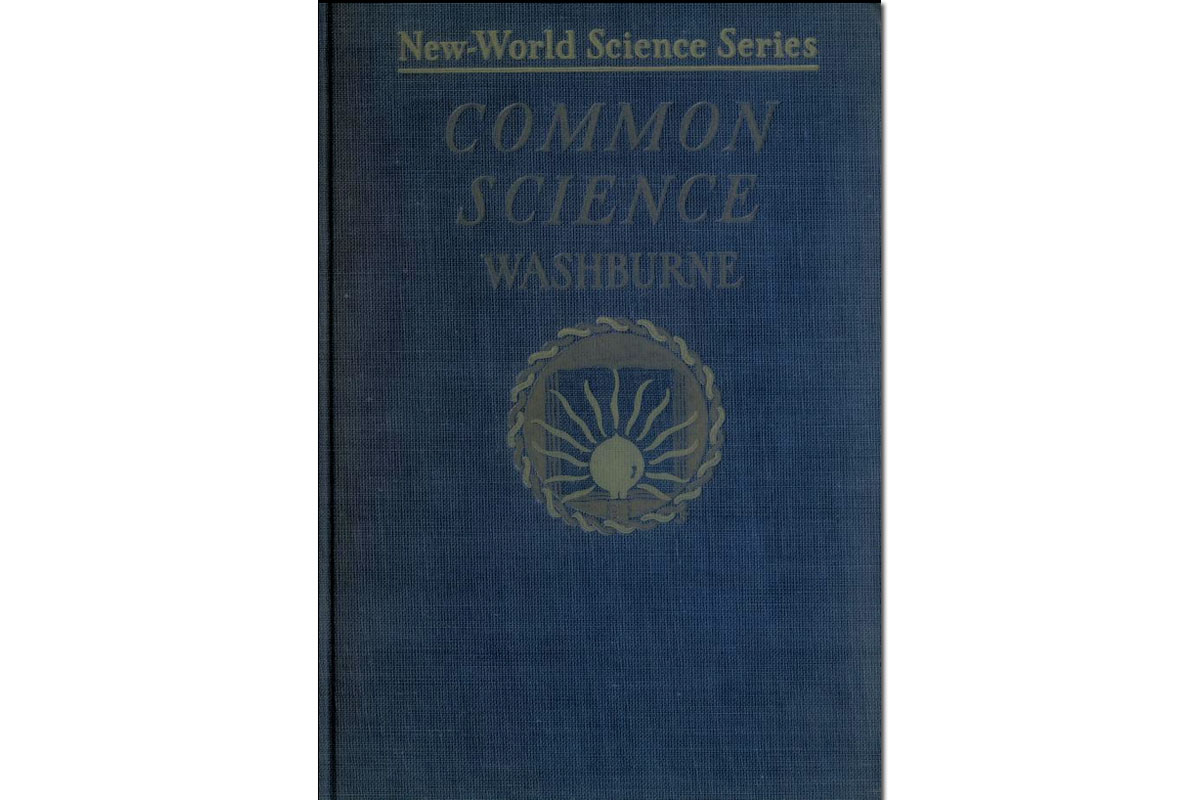

Common Science by Carleton W. Washburne is a science textbook that encourages students to learn scientific principles through narratives, experiments, and hands-on investigations.
This book is part of a science series published by World Book Company in the early 1900s that includes Science for Beginnersby Delos Fall, which we love and have already reviewed. Common Science takes the same fundamental approach.
A collection of about 2000 questions asked by children forms the foundation on which this book is built. Rather than decide what it is that children ought to know, or what knowledge could best be fitted into some educational theory, an attempt was made to find out what children want to know. The obvious way to discover this was to let them ask questions.
The questions were answered by demonstrating the principle behind the answers.
Topics covered include:
- Gravity.
- Molecules.
- Energy.
- Heat.
- Light.
- Sound.
- Electromagnetism.
- Chemical reactions.
- And more!
How The Book Works
Interestingly enough, if you ask someone what gravity is they can tell you what it does. But no one can really tell you what it IS. The book takes on these types of quandaries by answering in the following manner (in this rather long quotation but bear with):
Section 1. A real place where things weigh nothing and where there is no up or down.
- Why is it that the oceans do not flow off the earth?
- What is gravity?
- What is “down,” and what is “up”?
There is a place where nothing has weight; where there is no “up” or “down”; where nothing ever falls; and where, if people were there, they would float about with their heads pointing in all directions. This is not a fairy tale; every word of it is scientifically true. If we had some way of flying straight toward the sun about 160,000 miles, we should really reach this strange place.
Let us pretend that we can do it. Suppose we have built a machine that can fly far out from the earth through space (of course no one has really ever invented such a machine). And since the place is far beyond the air that surrounds the earth, let us imagine that we have fitted out the air-tight cabin of our machine with plenty of air to breathe, and with food and everything we need for living. We shall picture it something like the cabin of an ocean steamer. And let us pretend that we have just arrived at the place where things weigh nothing:
When you try to walk, you glide toward the ceiling of the cabin and do not stop before your head bumps against it. If you push on the ceiling, you float back toward the floor. But you cannot tell whether the floor is above or below, because you have no idea as to which way is up and which way is down.
As a matter of fact there is no up or down. You discover this quickly enough when you try to pour a glass of water. You do not know where to hold the glass or where to hold the pitcher. No matter how you hold them, the water will not pour—point the top of the pitcher toward the ceiling, or the floor, or the wall, it makes no difference. Finally you have to put your hand into the pitcher and pull the water out. It comes. Not a drop runs between your fingers—which way can it run, since there is no down? The big lump of water stays right on your hand. This surprises you so much that you let go of the pitcher. Never mind; the pitcher stays poised in mid-air. But how are you going to get a drink? It does not seem reasonable to try to drink a large lump of water. Yet when you hold the lump to your lips and suck it you can draw the water into your mouth, and it is as wet as ever; then you can force it on down to (or rather toward) your throat with your tongue. Still you have left in your hand a big piece of water that will not flow off. You throw it away, and it sails through the air of the cabin in a straight line until it splashes against the wall. It wets the wall as much as water on the earth would, but it does not run off. It sticks there, like a splash-shaped piece of clear, colorless gelatin.
Suppose that for the sake of experimenting you have brought an elephant along on this trip. You can move under him (or over him—anyway between him and the floor), brace your feet on the floor, and give him a push. (If he happens to step on your toes while you are doing this, you do not mind in the least, because he does not weigh anything, you know.) If you push hard enough to get the elephant started, he rises slowly toward the ceiling. When he objects on the way, and struggles and kicks and tries to get back to the floor, it does not help him at all. His bulky, kicking body floats steadily on till it crashes into the ceiling.
No chairs or beds are needed in this place. You can lie or sit in mid-air, or cling to a fixture on a wall, resting as gently there as a feather might. There is no need to set the table for meals—just lay the dishes with the food on them in space and they stay there. If the top of your cup of chocolate is toward the ceiling, and your plate of food is turned the other way, no harm is done. Your feet may happen to point toward the ceiling, while some one else’s point toward the floor, as you sit in mid-air, eating. There is some difficulty in getting the food on the dishes, so probably you do not wish to bother with dishes, after all. Do you want some mashed potatoes? All right, here it is—and the cook jerks the spoon away from the potatoes, leaving them floating before you, ready to eat.
It is literally a topsy-turvy place.
The book goes on to explain why water doesn’t fall off of the earth, why the world does not fall down, and why there is a place where things weigh nothing. (Obviously, you will want to explain that we do in fact have machines that can “fly out from the earth through space.”)
After this explanation, the student is asked to apply his knowledge:
Application 1. Explain why the people on the other side of the earth do not fall off; why you have weight; why rivers run downhill; why the world does not fall down.
As you can see by this example, the book is engaging! (For comparison, try NASA’s answer aimed at kids.)
There are:
- 6oo questions to explain the answers to (“Inference Exercises”).
- 116 experiments.
- 91 photos or illustrations.
- 86 applications.
- 58 sections for analysis (topics).
- A well-fleshed out index.
Going at the Student’s Pace
The book is laid out such that students can use the “individual system where each child does his own work at his natural rate of progress.” In this way it is expected that a student would finish the book within one school year.
The beauty of a book like this is that it encourages the student to think, to be involved, to experiment, to find out, and to apply what he has learned. Think notebook!
The children can carry on the work with almost no assistance from the teacher, if provision is made for their doing the experiments themselves and for their writing the answers to the inference exercises.
It should be noted that at this age the author does not support having students work through the scientific method. That is probably a correct approach (although there are simple forms to help younger students work through the concepts). The idea is to encourage observation and thinking (think of it as an informal approach to the scientific method) so that the curiosity in these younger years will propel the same curiosity in the upper-level classes where the scientific method is engendered. Nevertheless, a notebook to record things of importance to the student will be valuable. Narrations can form the largest part of the notebook.
Younger students can start with Science for Beginners. Common Science is a great selection for upper elementary/junior high ages… and free!
Free eBook
Additional Resources

10 Ways to Use Notebooking: #7 Science
Everything you need to get started!
Easy Science Experiments ~ Featured Site!
If you need help with the experiments.
Keep Reading

Physicus: A Fun Way to Learn Physical Science
Physicus: A Fun Way to Learn Physical Science ~ a great way to put textbook knowledge to “practical” use. Highly recommended!

Men of Science, Men of God ~ Review & Suggestions
101 scientists who “believed in the Bible and in a personal Creator God.”

Exploring the World of Physics ~ Review
Exploring the World of Physics: Simple Machines to Nuclear Energy is an introduction to physics for middle school ages.