


Have your student read the following information on the monarch butterfly:
One of the best ways to become interested in butterflies is to make a study of a single specimen. Since the Monarch is one of the most common, we have chosen him for study.
The upper surface of the wings is light tawny brown, with the borders and veins black, and with two rows of white spots on the fore ribs and outer borders. In the male, the veins of the wings have narrow black margins, and there are black pouches on the hind wings containing scent-scales.
The food of the Monarch is the milkweed, for which reason he is often called the milkweed butterfly. In searching for the Monarch, do not overlook his feeding ground, for he is often found in great numbers in a patch of milkweed.
The male Monarch is the dandy among butterflies. He is not only neat in figure and gorgeous in color, but on each hind wing he carries a black perfume bag to attract his ladylove. She is as brilliant as he, but lacks the perfume packets on her wings.
Birds leave the Monarch strictly alone, for the same reason that the little black and white skunk is left alone. His scent is no more agreeable than that of the skunk, and if ever a bird were bold enough to eat one, he would never want another.
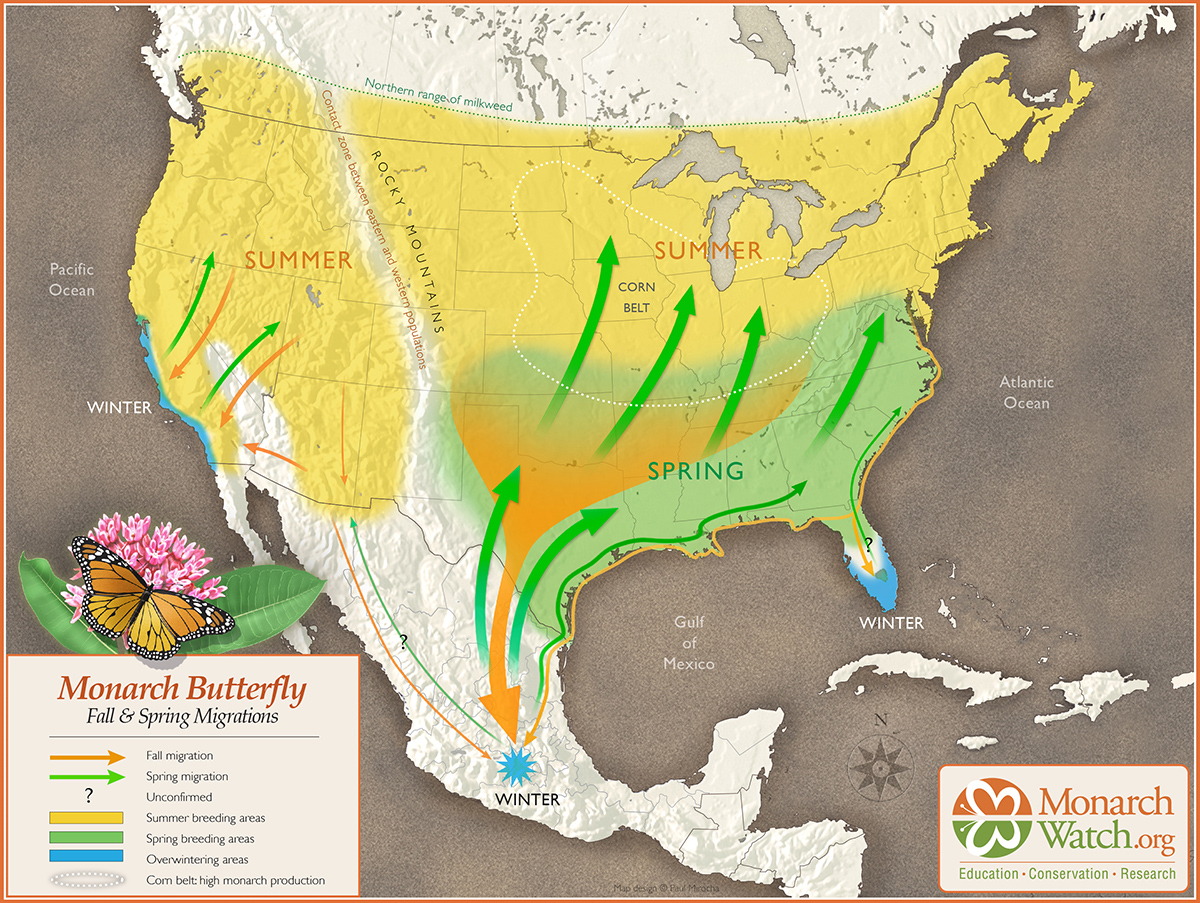
The Monarch is a great traveler. He migrates north in the spring after the manner of birds. The mother butterfly flies northward as far as she finds the milkweed sprouting; there she lays her eggs, and after a time dies. The eggs soon hatch a new brood of butterflies which, in turn, carries the journey another long distance northward to new feeding grounds.
With the approach of cool weather, the Monarchs gather in great flocks and start for the Southland. How they find their way back is a mystery. Unlike the birds, which usually have several experienced travelers in the flock, the butterfly flock is made up of the young travelers; but, in spite of youth and lack of guides, somehow the flock finds its way home.
This particular kind is well named the Monarch, for it is the most daring and strongest flyer of all butterflies. Not only does he take these long flights north and south, but he has been seen five hundred miles out at sea and, indeed, has been seen as far east as Europe and as far west as the islands of the Pacific. Of what birds can as much be said?
“The Monarch Butterfly,” The Lincoln Readers
Suggestions
Have your students do one or more of the following:
- Create a notebook for your project.
- Younger students can provide an oral narration.
- Older students can provide a written narration.
- Use Drawing and Writing paper to draw and illustrate a Monarch butterfly.
- Explain why birds tend to leave monarch butterflies alone.
- Compare/contrast the migration of birds with that of butterflies.
- Explain why the author believes “Monarch” is a suiting name for these butterflies.
- Younger students can list their favorite facts about the butterfly.
- Older students can outline the piece.
Additional Resources
Monarch
From the Alabama Butterfly Atlas. Very informative with illustrated diagram for distinguishing male from female.
Monarch Butterfly Identification
How to tell if a butterfly is a boy or a girl. Nicely illustrated photos from the National Wildlife Federation.
Monarch Butterflies
Questions and answers from Dr. Karen Oberhauser at the Arboretum at the University of Wisconsin-Madison.
Milkweed
More about the “food of the Monarch” at Birds&Blooms.
Activities
Plant Milkweed for Monarchs
From the Forest Service.
Monarch Butterfly Interactive Map
From the National Wildlife Federation.
Books
“The Milkweed Butterflies”
From How to Know the Butterflies by the Comstocks.

Butterflies {Free Download}
“Butterflies” is a free download covering why study butterflies, their organization and migration, types, and caterpillars.
The Butterfly Book ~ Free eBook
Covers the anatomy and classification of North American butterflies by the same author as the above.
Units & Lesson Plans

Free Nature Studies: Butterflies & Moths
Butterflies live very short lives, progressing from egg, to caterpillar, to chrysalis, to butterfly. Unit resources from our free nature study series.
Printables & Notebooking pages
Monarch Butterfly Fall Migration Map
For notebook.
Migration Map
From MonarchWatch.org.
Keep Reading

Insect Coloring Book ~ Free Download
Free from the Smithsonian Science Education site, an insect coloring book just in time for summer insect fun!

10 Things to Put in Your Nature Journal
Spring is a great time to get outside and observe. Suggestions for 10 things to put in your nature journal.


Hunt Jackson, Helen: “September”
The golden-rod is yellow; The corn is turning brown;— …. Poetry study.