
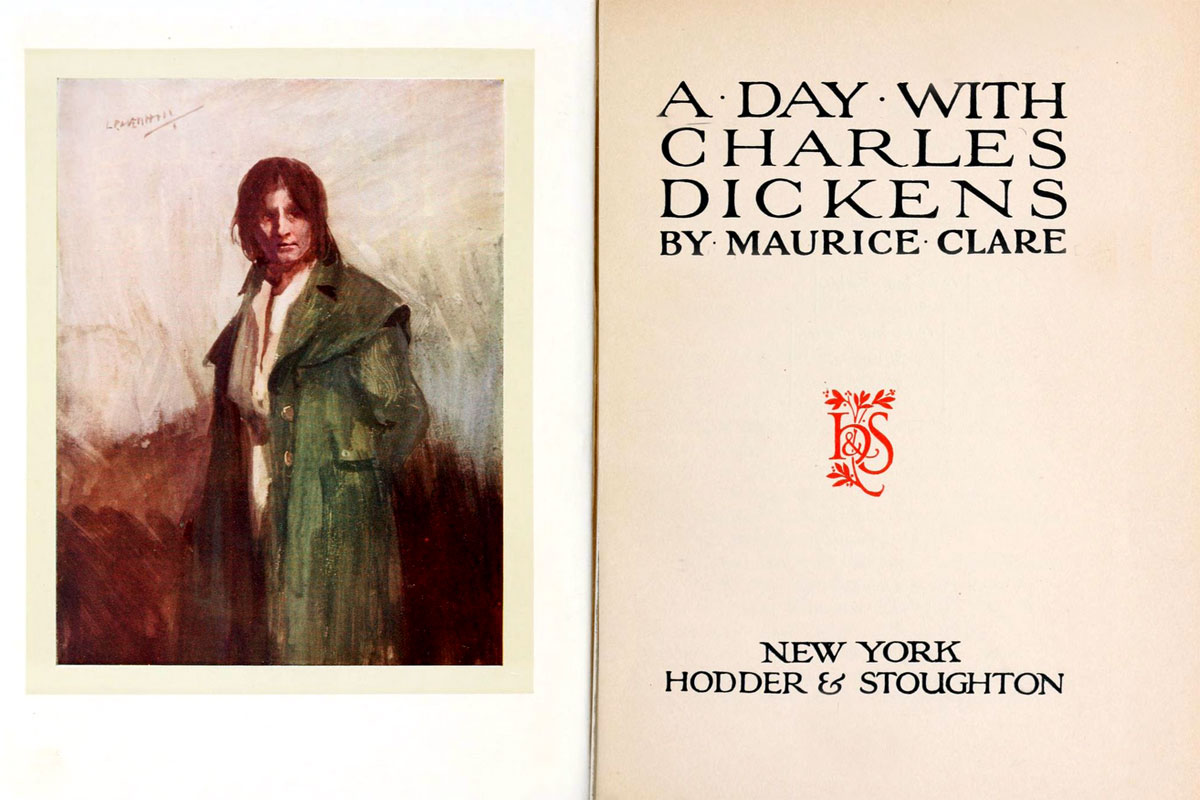

A Day with Charles Dickens by May Byron (pseud. Maurice Clare) is a public domain title (free eBook) that explores Dickens as a writer.
No writer, it has been said, ever lived, of greater industry and more systematic method….
He could not write unless everything was placed exactly ready to his hand in apple-pie order, and unless he had, ranged around and before him, that singular variety of objects upon which he wished his eye to rest in any momentary respite from actual work. A little cup full of fresh flowers was invariably one of those objects, — a bronze group of toads duelling — a gilt leaf with a seated rabbit — a huge paper knife — a French statuette of a dog-fancier carrying a multiplicity of little dogs. And, amongst these heterogeneous odds and ends, the most popular and the most widely-read man of his time — perhaps of any time — evolved his intricate plots, and created that unrivalled portrait-gallery, which was and is unique in the annals of literature.
Some authors are organized, others are not. Each has his/her own style and way of approach. (Mark Twain worked for a season, then vacationed — likely developing ideas while he wasn’t writing.)
But Charles Dickens was a very organized writer. He approached the task as his true occupation. His household was kept orderly. He enjoyed his routine: breakfasted at 9:00, and when all was in order walked to his work.
His orderly nature explains his detailed observations…and the quantity of work he was able to produce.
“I never could have done what I have done,” he said, “without the habits of punctuality, order and diligence; without the determination to concentrate myself upon one object at a time, no matter how quickly its successor should come upon its heels… Whatever I have tried to do in life, I have tried with all my heart to do well… In great aims and small, I have always been thoroughly in earnest.”
Some authors write to know what they wish to say. Others create an outline to follow, filling in as they go. Much like C.S. Lewis, Charles Dickens saw what he needed to get down on paper.
“When I sit down to my book,” he wrote, “some beneficent power shows it all to me, and tempts me to be interested, and I don’t invent it — really do not — but see it, and write it down.… It is only when it all fades away and is gone, that I begin to suspect that its momentary relief has cost me something.”
After writing three hours in the morning, Dickens would take lunch and exercise before returning to his work. If not writing, this time would be engaged in other literary endeavors (such as editing), not stopping until dinner.
After dinner, Dickens would take one of his long walks. (It was during one of these walks that he birthed The Christmas Carol.) Then return home at a particular hour to sleep.
A Day With Charles Dickens is part of a series of books depicting the lives of famous authors. This one about Dickens is a favorite.
Free eBook
Suggestions
Ask your students to do one or more of the following:
- Create a simple timeline of how Dickens spent his day.
- Create an author page for Dickens.
- What elements of Dickens’ character enabled him to be a great author? Make a list. Older students can create a character study.
Additional Resources
100 Best Books for Children ~ Dickens
Dickens’s A Child’s History of England is #43 on The Hundred Best Books for Children list found in The Book-lover. Lots of resources!
Dickens A Christmas Carol: A Unit Study
December 17, 2023, marked the 180th anniversary of A Christmas Carol by Charles Dickens. Unit resources.
Keep Reading

The Children of Dickens ~ Free eBook
24 tales about Charles Dickens and his characters, illustrated by Jessie Wilcox Smith.

7 Free Writing Lessons for December
Here is a free download with 7 writing lessons for December taken from Write Something Every Day.

14 Forms of Writing for the Older Student: Character Sketch
Character development is often one of the hardest tasks facing a writer. Here are ways to tackle the challenge!