
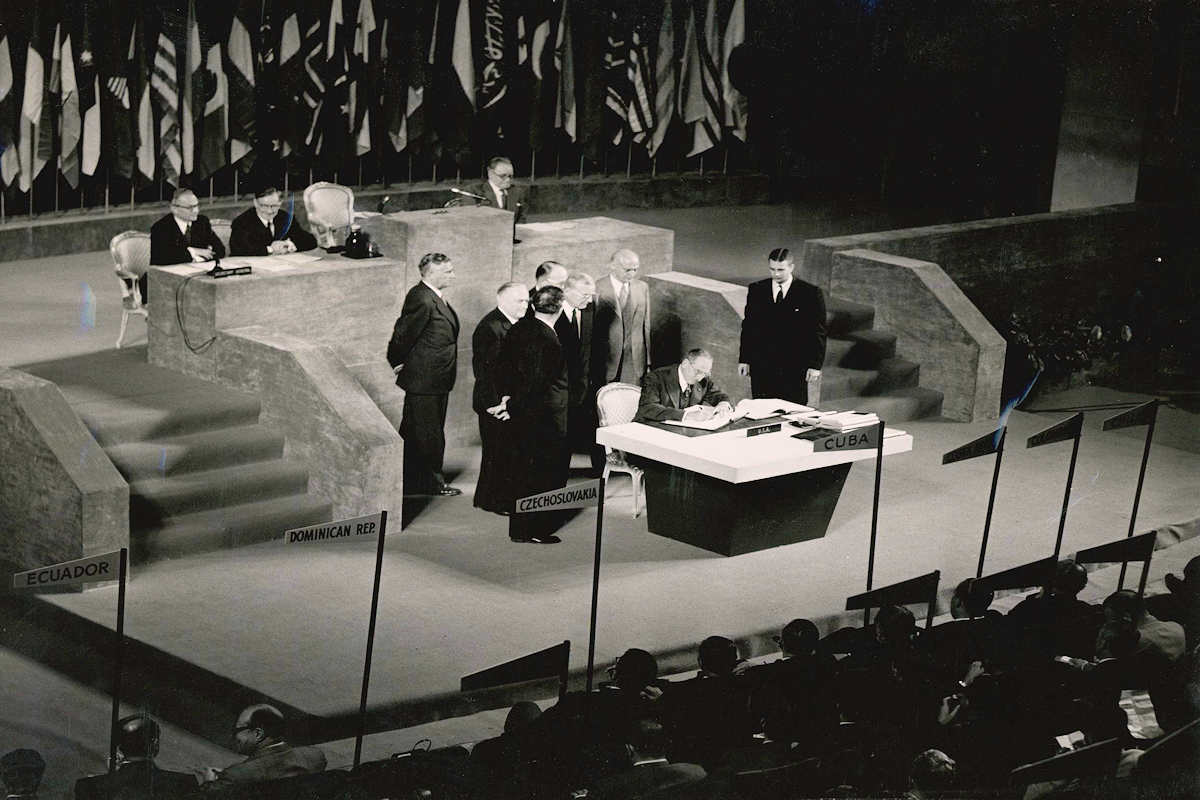

The Treaty of San Francisco was signed on September 8, 1951 by 48 allied nations, officially ending World War II and reestablishing Japanese sovereignty. Signed at the War Memorial Opera House in San Francisco the treaty went into effect on April 28, 1952.
Table of Contents
The Terms of the Treaty
Under the treaty, otherwise known as the Treaty of Peace with Japan:
- The Allied Powers recognized the full sovereignty of Japan.
- Japan renounced all rights and claims on various countries and islands including Korea, Taiwan, Hong Kong, and Antarctica.
- All occupation forces were to be withdrawn from Japan (except as outlined under new treaties with and agreed upon by Japan).
- Japan agreed to enter into negotiations on repayment of reparations to the Allied Powers for damage and suffering it caused during the war.
- Japan agreed to accept the judgments of the International Military Tribunal for the Far East and other Allied War Crime Courts both within and outside Japan.
The Treaty With Japan
The Bilateral Security Treaty between the United States of America and Japan was signed on the same day, and outlined the United States’ plans for maintaining a military presence in Japan to protect it from threats from other nations as Japan was officially disarmed by the Treaty of San Francisco. This additional treaty set the stage for the continued use of Japan as a staging area for US military operations in the Far East region. As the Korean War was still taking place it was viewed as critical that Japan be kept as a base for US military forces.
Soviet Opposition
The combined action of these two treaties inevitably led to strong opposition by the Soviet Union. Along with Poland and Czechoslovakia, they refused to sign the treaty. During the treaty-signing conference, the Soviet Union delegation led by Andrei Gromyko outlined significant objections. They asserted that the treaty did not provide any guarantees against the rise of Japanese militarism.
It was not until October 19, 1956, that Japan and the Soviet Union signed a Joint Declaration ending the war between the two nations and reestablishing diplomatic relations. Questions resulting from the legitimacy of existing governments and the state of war between North and South Korea prevented the Republic of China in Taiwan, the People’s Republic of China, and North and South Korea from attending the conference.
The signing statement by President Truman hailed the reborn nation as a valiant ally in the struggle against “communist imperialism and aggression in the Pacific.” The Soviet Union immediately denounced the two treaties. Their view was that they were “treaties for the preparation of a new war in the Far East” and an “illegal separate peace treaty with Japan.”
Suggestions
- Historical events never happen in isolation, even though we do tend to study them that way. What lasting effects of WWI led to WWII?
- What lasting effects of WWII led to the Cold War?
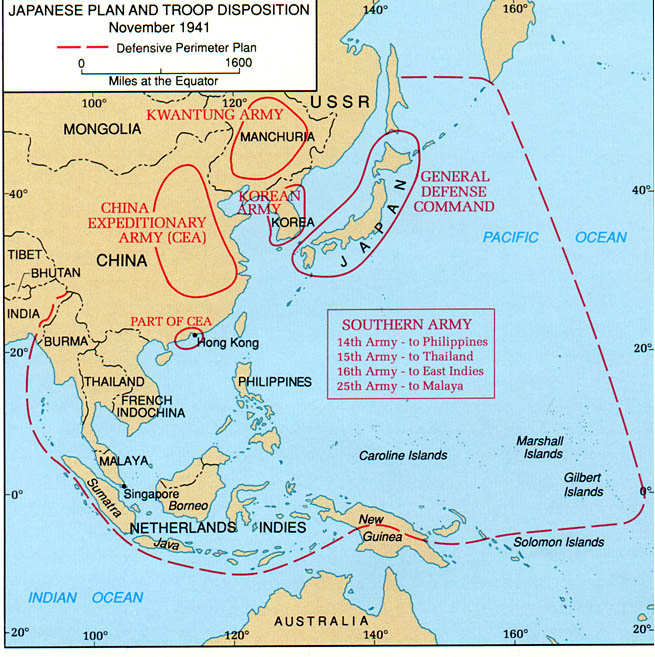
- Review the Japanese plan for taking and holding the Pacific. Make a chart showing the countries and islands the Japanese lost as a result of the Treaty of San Francisco and their disposition.
Further Investigation
World War II Chronology
Timeline from the U.S. Holocaust Museum.
Japanese Plan and Troop Disposition — November 1941
Map showing the Japanese defensive perimeter at that time. Note the countries they occupied.
The Treaty of San Francisco
The full text.
Harry S. Truman: Statement by the President Upon the Signing…
of the Treaty of Peace with Japan.
Activities
Remembering Pearl Harbor: Attack Map (archived)
Interactive map from National Geographic.
Interactive Map Maker {Free}
Create your own maps of the countries Japan held.
Unit Studies & Lesson Plans
Teaching With God’s Heart for the World
WWII and the South Pacific section from this free unit study with a focus on missions.

Harry S. Truman: A Unit Study
Another one of our units about the President who signed the peace treaty with Japan.
Printables & Notebooking Pages
Second World War Pacific Theater (archived)
Map showing the extent of the Japanese perimeter during the war (shown with red dotted line).
Globalmania
Very nice maps of Asia are included in this free KnowledgeQuest download.
Treaty of San Francisco Notebooking Pages
Simple pages for copywork, narrations, or wrapping up.
These units have been created specifically with do-it-yourself (DIY) homeschoolers in mind: those that don’t want a lot of hand-holding. If this doesn’t describe your need, you might prefer a few of these pre-planned units. For those brave souls who enjoy pulling things together themselves, there are many ways to use these resources!
Keep Reading

American Historical Documents {Free eBook}
One of the ways to make history real is to include primary source documents. American Historical Documents is an inexpensive {free} way to easily…

The Great San Francisco Earthquake: A Unit Study
The Great San Francisco Earthquake in 1906 explained why the ground moves. Unit resources.


Free Music Studies: Ludwig van Beethoven
Beethoven was a German pianist and composer spanning the transition from the late Classical period to the early Romantic period. Unit Resources.