
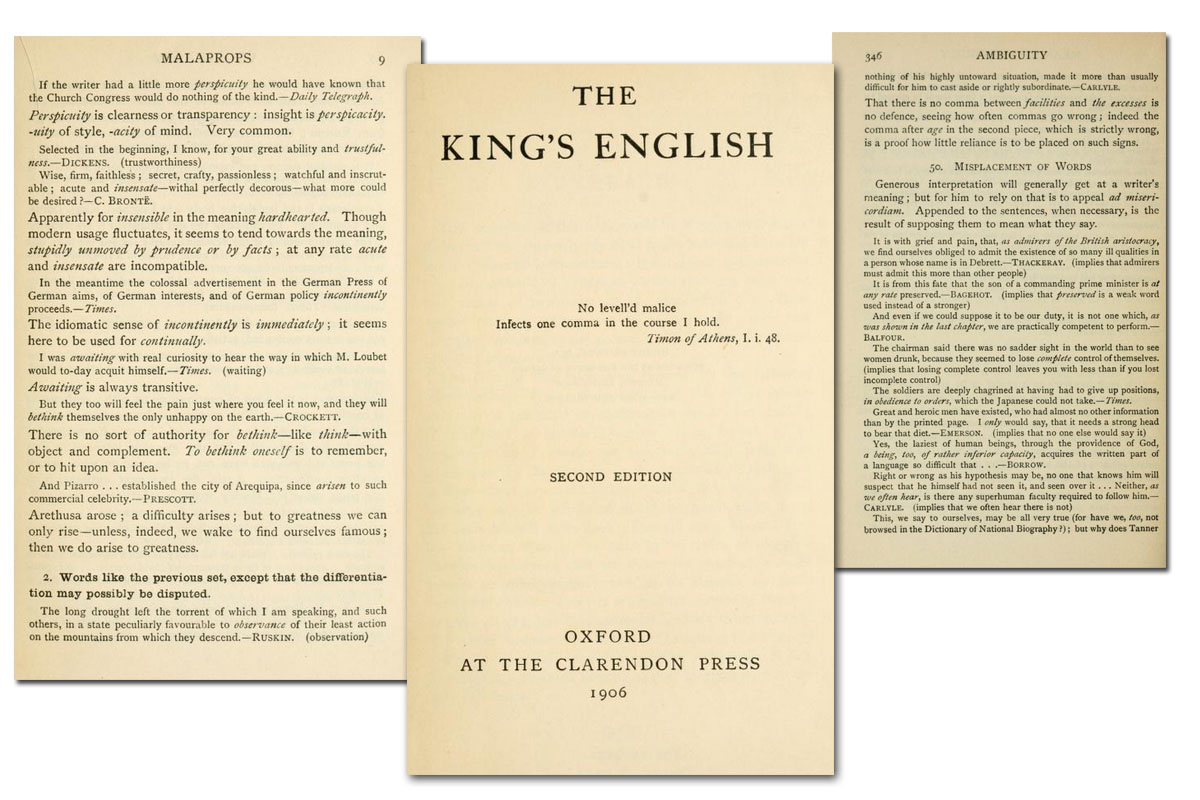

The King’s English written by Henry and Francis Fowler in the early 1900s is a classic English grammar reference. The beauty of this now public domain title is its practical use — despite its age.
It is notorious that English writers seldom look into a grammar or composition book; the reading of grammars is repellent because, being bound to be exhaustive on a greater or less scale, they must give much space to the obvious or the unnecessary; and composition books are often useless because they enforce their warnings only by fabricated blunders against which every tiro feels himself quite safe. The principle adopted here has therefore been (1) to pass by all rules, of whatever absolute importance, that are shown by observation to be seldom or never broken; and (2) to illustrate by living examples, with the name of a reputable authority attached to each, all blunders that observation shows to be common. The reader, however, who is thus led to suspect that the only method followed has been the rejection of method will find, it is hoped, a practical security against inconvenience in the very full Index.
Gotta love that intro!
We begin with vocabulary:
Any one who wishes to become a good writer should endeavour, before he allows himself to be tempted by the more showy qualities, to be direct, simple, brief, vigorous, and lucid.
This general principle may be translated into practical rules in the domain of vocabulary as follows:—
Prefer the familiar word to the far-fetched.
Prefer the concrete word to the abstract.
Prefer the single word to the circumlocution.
Prefer the short word to the long.
Sounds a bit like something you might find in The Elements of Style. The principles are practical … and attainable!
The examples are valuable to students working through the book. For example, under, “Prefer the familiar word to the far-fetched”:
Buttercups made a sunlight of their own, and in the shelter of scattered coppices the pale wind-flowers still dreamed in whiteness.—E. F. Benson.
We all know what an anemone is: whether we know what a wind-flower is, unless we happen to be Greek scholars, is quite doubtful.
The vocabulary section also covers the malaprop, defined as: “a word used in the belief that it has the meaning really belonging to another word that resembles it in some particular.” Is it reverend or reverent, for example.
Other interesting topics include:
- Syntax (case, number, gerunds, etc.).
- Airs and graces (humor, metaphors, repetition, etc.).
- Punctuation.
- Sounds (jingles, alliteration, etc.).
- Quotation.
- Grammar.
- Meaning.
- Style.
There is an amazing breadth of topics covered that one would not normally encounter in a typical language class. Nevertheless, writers, and editors in particular, will find the time spent plumbing the depths valuable.
An easy way to use these examples is to simply rewrite the sentences in the simple way. Perhaps assure the principle is taken by having your student write a modern example taken from his current read. Of course, if you have a student who loves words, he may simply take the book and run.
Have a copybook handy. There are many jewels worth noting.
The climax is reached by those pessimists who, regarding the reader’s case as desperate, assist him with punctuation, italics, and the like:
And this honourable (?) proposal was actually made in the presence of two at least of the parties to the former transaction!
The much-prated-of ‘kindness of heart’ and ‘generosity’ possessed by millionaires, generally amounts to this kind of thing.—Corelli.
This is a great book! Download it! You’ll love it! 😀
Free eBook
- Read online
- Various formats (EPUB, Kindle)
Additional Resources

How to Write Clearly
If The King’s English is just too much, Dr. Beechick’s ideas when it comes to writing are summarized in her book, How to Write Clearly: The Meaning Approach. And she always keeps it simple. Read our full review.

The Elements of Style
The Elements of Style covers usage, composition, spelling, and commonly misused words. But perhaps it is the manner in which it covers these topics that has kept it in the public eye. Same idea; more modern take. Read our full review.
Keep Reading

Learn to Write, Write!
Ready to get started writing? Learn to Write, Write! is your guide to discovering and practicing the art of writing. It is by writing…

Beechick Basics
Dr. Ruth Beechick was a skilled teacher and curriculum developer who considered home the best place to learn.

Grammar Workshop: Fumblerules
William Safire, a Pulitzer-Prize-winning journalist, created “The Fumblerules of Grammar” to humorously illustrate common grammar mistakes.