
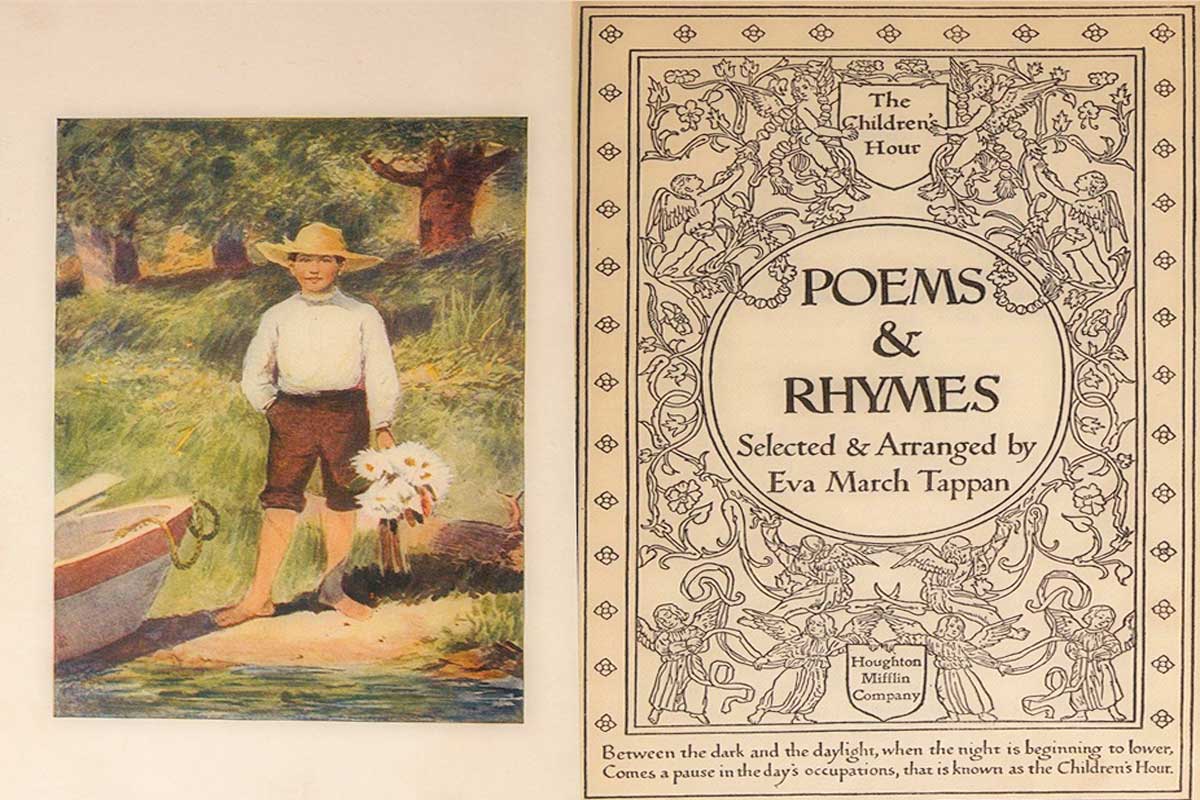

The Children’s Hour was a set of ten illustrated volumes published in the early 1900s by Houghton, Mifflin, and Company. The set featured “a comprehensive and careful selection of the best literature for children” including folk stories, myths, heroes, legends, and more. This volume features poems and rhymes selected by Eva March Tappan.
In this book there are some rhymes inserted because they are especially amusing or because they tell a story so well; but most of the volume is made up of true poetry. Just what true poetry is, no one has been able to put into words, because what makes the special excellence of one poem may not appear at all in another…. However, even if poetry cannot be defined, you can learn to recognize it when you come to it, and you can get a great deal of pleasure not only from merely reading it, but also from noting in different poems what it is that you enjoy.
You will recognize many of the poems — beginning with “The Children’s Hour” by Longfellow.
Other works include those from:
- William Blake.
- Elizabeth Barrett Browning.
- Robert Browning.
- William Cullen Bryant.
- Robert Burns.
- Samuel Taylor Coleridge.
- Emily Dickinson.
- Ralph Waldo Emerson.
- Eugene Field.
- Oliver Wendell Holmes.
- Charles Lamb.
- Edward Lear.
- James Russell Lowell.
- George MacDonald.
- John Milton.
- Edgar Allan Poe.
- Sir Walter Scott.
- William Shakespeare.
- Percy Blythe Shelley.
- Robert Louis Stevenson.
- Alfred Tennyson.
- Walt Whitman.
- John Greenleaf Whittier.
- Many, many more.
You will find many of the poets in our Online Poetry Anthology.
The poems are arranged in the following categories:
- Poems about children.
- Story-telling poems.
- Nonsense verse.
- Songs.
- Christmas poems.
- Poems of nature.
- Poems of our country.
- Poems to think about.
- Other poems.
The way we approached poetry was to read several poems by the same poet to better become familiar with that poet’s style and work. Frequently the task is made easier by an author index in the back. Unfortunately, this book does not have an index. If you choose to follow that course you can skip along from the table of contents in the front.
Frequently it is best to simply read aloud one poem each day. This way the task doesn’t become arduous. Young children rarely enjoy sitting still for long periods of time, not to mention listening to poetry … especially long readings!
There is a right way and a wrong way, however, to meet these poem-friends. The right way is first to read a poem and enjoy it without stopping to study or to think what its best points are, — just as you would meet a new person. But when a person has become your friend, you are much more likely to appreciate him if you stop once in a while and think what it is in him that is so lovable. It is the same way with a poem that pleases you. If you stop and think what it is that has given you pleasure, you will be likely not only to learn why, but to get much more pleasure from it. You will be sure to find that there is, either in sound or thought or picture-making or in its power to produce a mood, some excellence that could not have been found in a prose composition on the same subject; and the reason is — because it is a poem.
Very nice collection…and free!
Free eBook
- Read online
- EPUB (convert to Kindle)
Additional Resources
4 Ways to Incorporate Poetry ~ Resources
Help if you are new to this sort of thing.
Keep Reading

14 Forms of Writing for the Older Student: Poetry
Some students will find writing poetry easier task than many other forms of writing.

Activity: Rewrite a Poem in Story Form
Using Robert Frost’s poem “Stopping by Woods on a Snowy Evening,” students are encouraged to envision the scene and then rewrite the poem as…

Poems Every Child Should Know ~ Free eBook
Poems Every Child Should Know is a free book of poetry that children will be excited to encounter of their own free will.