
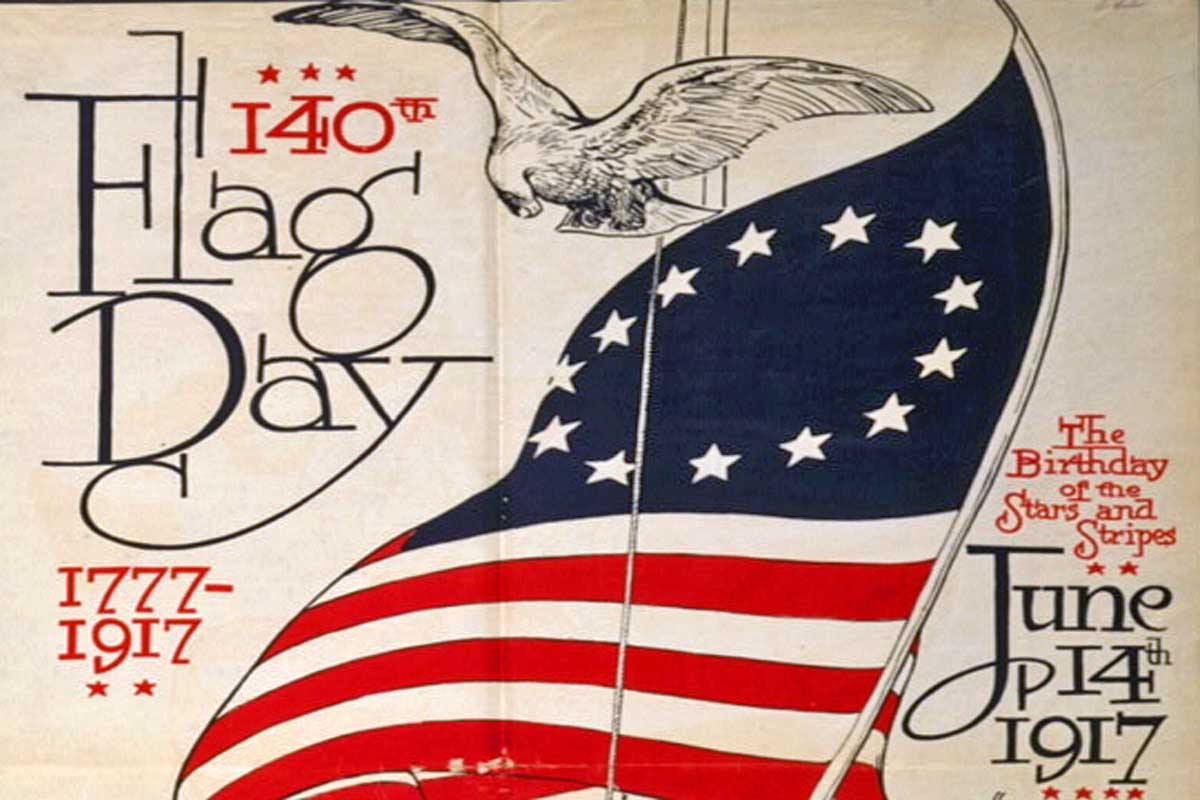

In the United States, Flag Day celebrates the adoption of the United States flag on June 14, 1777, by the Second Continental Congress. However, the event was not commemorated until 1861.
Table of Contents
Origins
The first known person to suggest celebrating the day on which the flag was adopted was George Morris. He hoped the celebration would promote patriotism. His observance of Flag Day was short-lived.
The earliest widely recognized father of Flag Day was Bernard Cigrand, a grade school teacher in Wisconsin who, after celebrating Flag Day at school in 1885, declared that we needed to promote patriotism and respect for the flag of the United States once a year. The idea at last began to gain ground.
Interestingly, even today Flag Day isn’t an official public holiday, despite being established by Woodrow Wilson’s presidential proclamation in 1916 and as an Act of Congress in 1949 as a day to honor the flag. Rather, it is a day to fly and honor the flag, to be officially announced by the President for observance, if he so chooses. And actually, the President declares not only a flag day but also flag week, in which Americans are urged to fly the flag of the United States of America.
The First Flag
The first flag of the United States, adopted on June 14, 1777, was to be a flag with thirteen stars and thirteen stripes. No particular arrangement was specified. The thirteen stars and stripes were to represent the thirteen original British colonies along the East Coast.
It is generally accepted that Betsy Ross designed and created the first flag with its thirteen stars and stripes and arranged the stars in a circle. Unfortunately, there appears to be no ground for this belief beyond family tradition. There is no written reference to this flag until after the supposed date of manufacture. In fact, many places claim to be the home of the original flag, but none of them can provide decisive proof. The creator of the first flag of the United States and where it was originally located has been lost in history.
In the early days of the American flag, the person who sewed the flag designed it as well. The design would change from person to person. The convention that was normally followed was a flag much like our modern one, only with thirteen stars.
Evolution

The flag, meanwhile, continued to evolve as states were added to the union. After Vermont and Kentucky were added, Congress produced a flag with fifteen stars and fifteen stripes to accommodate the two new states. The Star-Spangled Banner, the flag which inspired the national anthem, was of such a design.
Finally, as more states continued to be added, it was decided that thirteen stripes would represent the original thirteen colonies, and the number of stars on the flag would be equal to the number of states in the union. This arrangement persists today.
Flying the Flag
There are several conventions and signs of respect that apply when flying the flag. For example:
- If the national flag is displayed horizontally on a flat surface, the “union,” the blue section with the stars, is always on the left.
- The same goes for a vertical display, the union being on the upper left.
- When a flag is raised half-mast on a pole, the flag is first raised all the way to the top, and then lowered to a position half of the way down the pole.
- When displayed amidst a group of state and city flags, the national flag is always the highest, and is in the center.
- When two flags are displayed at the sides of a speaker’s podium, the national flag is at the place of honor to the speaker’s right, and the other flag to his left.
- In a parade with several flags, the national flag is placed at the marcher’s right, or, as is the case in a row of flags, the national flag comes in the center front.
- A badly soiled flag or tattered United States flag is not to be displayed; a flag beyond use is to be burned, not thrown away.
Flag Day is the day in June on which our national flag is flown, celebrating the adoption of the stars and stripes by the Continental Congress in 1777. The flag is to be displayed honorably, and is to be respected.
Suggestions
Have your students do one or more of the following:
- Fly the flag on June 14th!
- Practice the proper way to fold a flag.
- Wear red, white, and blue!
- Memorize the Pledge of Allegiance.
- Draw a picture of the flag on Drawing and Writing Paper. Below, explain what the flag means.
- Take a drive and count the flags you see flying on Flag Day.
- Copy the poem “The Flag Goes By,” by Henry Holcomb Bennett (see resources below).
- Create a timeline showing when each star was added to the flag.
- Watch Red Skelton explain the meaning of the Pledge of Allegiance:
Further Investigation
The History of the American Flag ~ For Kids
Nice summary.
The Origins of Flag Day
Download from the VA.
Flag Day Celebrated (archived)
Simple history and background from the Library of Congress America’s Story site for kids.
Our Flag
Introduction, history, evolution, care, and Flag Day background from the U.S. Joint Committee on Printing.
Flag Timeline
Chart showing the various U.S. flags through history.
“Old Glory”
Background on our flag’s nickname.
How to Respect the American Flag
From the American Flag Foundation.
Activities
Interactive Flag
From the Smithsonian.
The Birth of Old Glory
View the painting by Edward Percy Moran.
How to Cut a 5-Pointed Star
In one snip!
Folding the Flag
Step-by-step guide.
Design Your Own Flag
Free download from the National Constitution Center that walks you through it.
American Flag Pinwheels
Free to download and fold from the National Constitution Center.
Flag Cake
Fun and simple recipe!
July 4th Activity Book
At EnchantedLearning.com.
Books
“The Flag Goes By”
A favorite poem by Henry Holcomb Bennett that can be used for copywork or simply read for enjoyment. From the public domain work Poems Every Child Should Know by Mary E. Burt.

Betsy Ross: Designer of Our Flag by Ann Weil
Part of the Childhood of Famous Americans series, simple biography for younger readers.
How the Flag Became Old Glory ~ Free eBook
For Flag Day, a free eBook covering the history of the flag through poems and prose.
Our Flag: Its History and Changes From 1620 to 1860 by Sarah E. Champion
Free download of a book made from a manuscript originally presented to the Daughters of the American Revolution in 1895. Wonderful illustrations of the flags throughout the years that can be downloaded in PDF form and printed for notebook.
Our American Holidays: Flag Day edited by Robert Haven Schauffler
Free public domain book that includes poetry and stories that can be used for copywork, memorization, or simply reading aloud.
The American Calendar: Flag Day
Online book with extensive detail and very helpful resources.
Unit Studies & Lesson Plans
The Pledge of Allegiance
Lesson plan for little ones from Hubbard’s Cupboard.

Free Civic Studies Lesson 12: The Flag
Part of our free civic book studies. Includes many more resources!
Stars, Stripes and Symbols of America: Comparing Our Flag, Past and Present
Lesson plan from the Library of Congress that explores the flag. Includes nice printables.
Make a Flag
Lesson idea from Enchanted Learning where students design their own flag, choosing shapes, colors, and images that represent them.
The History of Flag Day
Lesson plan from the National Constitution Center.
Stars and Stripes Forever: Flag Facts for Flag Day
Three lesson activities from the National Endowment of the Humanities.

Free History Studies: The Star-Spangled Banner
Part of our free history studies that includes more suggestions, background information, mapwork, copywork, interactives, book suggestions, lesson plans, printables, and notebooking helps dealing with the Star-Spangled Banner.
Printables & Notebooking Pages
American Flag Printable
Color flag great for notebook from WorkWithColor.com (scroll to bottom).
U.S. Flag
Flag coloring page at PrintFree.com.
Poster Flag
Another flag coloring page option at DLTK-Kids.com
20 Free Printable Flag Day Coloring Pages
Particularly well done!
Flag Day Notebooking Pages
Simple pages for copywork, narrations, or wrapping up.
These units have been created specifically with do-it-yourself (DIY) homeschoolers in mind: those that don’t want a lot of hand-holding. If this doesn’t describe your need, you might prefer a few of these pre-planned units. For those brave souls who enjoy pulling things together themselves, there are many ways to use these resources!
Keep Reading

Free Civics Studies Lesson 12: The Flag
Free Civics Studies Lesson 12: The Flag. The meaning of a flag and the history of “Old Glory.”

How the Flag Became Old Glory ~ Free eBook
For Flag Day, a free eBook, How the Flag Became Old Glory, covering the history of the flag through poems and prose.


Our American Holidays: Flag Day {Free eBook}
Another free eBook in the Our American Holidays series. Flag Day edited includes poetry and stories that will complement our free Flag Day unit.