
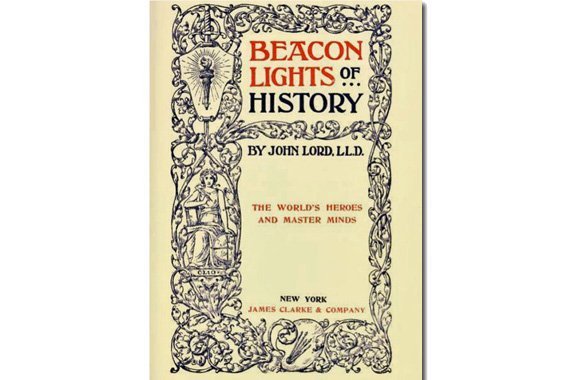

The Beacon Lights of History is a 12-volume series written by John Lord in the late 1800s to early 1900s. If you are looking for a history spine written from a Christian perspective, you’ll find the Beacon Lights an excellent world history “text” for the older student.
It has been my object in these Lectures to give the substance of accepted knowledge pertaining to the leading events and characters of history; and in treating such a variety of subjects, extending over a period of more than six thousand years, each of which might fill a volume, I have sought to present what is true rather than what is new.
Volumes 1-12 were written by Lord. Volume 13 was completed from his notes with missing pieces authored by other writers. The remaining volumes were written by other writers after his death, and cannot be as easily recommended.
Below are the contents of each volume to give you the flavor and depth of the series. Our tips for using the series are below.
Free eBooks:
Volume:
1: The Old Pagan Civilizations
- Ancient Religions: Egyptian, Assyrian, Babylonian, and Persian
- Religions of India: Brahmanism and Buddhism
- Religion of the Greeks and Romans: Classic Mythology
- Confucius: Sage and Moralist
- Ancient Philosophy: Seeking After Truth
- Socrates: Greek Philosophy
- Phidias: Greek Art
- Literary Genius: The Greek and Roman Classics
- Abraham: Religious Faith
- Joseph: Israel in Egypt
- Moses: Jewish Jurisprudence
- Samuel: Israel Under Judges
- David: Israelitish Conquests
- Solomon: Glory of the Monarchy
- Elijah: Division of the Kingdom
- Isaiah: National Degeneracy
- Jeremiah: Fall of Jerusalem
- Judas Maccabaeus: Restoration of the Jewish Commonwealth
- Saint Paul: The Spread of Christianity
- Governments and Laws: Greek and Roman Jurisprudence
- The Fine Arts: Architecture, Sculpture, Painting
- Ancient Scientific Knowledge: Astronomy, Geography, Etc.
- Material Life of the Ancients: Mechanical and Useful Arts
- The Military Art: Weapons, Engines, Discipline
- Cicero: Roman Literature
- Cleopatra: The Woman of Paganism
- Pagan Society: Glory and Shame
- Cyrus the Great: Asiatic Supremacy
- Julius Caesar: Imperialism
- Marcus Aurelius: Glory of Rome
- Constantine the Great: Christianity Enthroned
- Paula: Woman as Friend
- Chrysostom: Sacred Eloquence
- Saint Ambrose: Episcopal Authority
- Saint Augustine: Christian Theology
- Theodosius the Great: Latter Days of Rome
- Leo the Great: Foundation of the Papacy
- Mohammed: Saracenic Conquests
- Charlemagne: Revival of Western Empire
- Hildebrand: The Papal Empire
- Saint Bernard: Monastic Institutions
- Saint Anselm: Mediaeval Theology
- Thomas Aquinas: The Scholastic Philosophy
- Thomas Becket: Prelatical Power
- The Feudal System
- The Crusades
- William of Wykeham
- John Wyclif: Dawn of the Reformation
6: Renaissance and Reformation
- Dante: Rise of Modern Poetry
- Geoffrey Chaucer: English Life in the Fourteenth Century
- Christopher Columbus: Maritime Discoveries
- Savonarola: Unsuccessful Reforms
- Michael Angelo: The Revival of Art
- Martin Luther: The Protestant Reformation
- Thomas Cranmer: The English Reformation
- Ignatius Loyola: Rise and Influence of the Jesuits
- John Calvin: Protestant Theology
- Lord Bacon: The New Philosophy
- Galileo: Astronomical Discoveries
- Heloise: Love
- Joan of Arc: Heroic Women
- Saint Theresa: Religious Enthusiasm
- Madame de Maintenon: The Political Woman
- Sarah, Duchess of Marlborough
- Madame Recamier: The Woman of Society
- Madame de Stael: Woman in Literature
- Hannah More: Education of Woman
- George Eliot: Woman as Novelist
- Alfred the Great: The Saxons in England
- Queen Elizabeth: Woman as a Sovereign
- Henry of Navarre: The Huguenots
- Gustavus Adolphus: Thirty Years’ War
- Cardinal Richelieu: Absolutism
- Oliver Cromwell: English Revolution
- Louis XIV: The French Monarchy
- Louis XV: Remote Causes of Revolution
- Peter the Great: His Services to Russia
- Frederic the Great: The Prussian Power
- Mirabeau: The French Revolution
- Edmund Burke: Political Morality
- Napoleon Bonaparte: The French Empire
- Prince Metternich: Conservatism
- Chateaubriand: The Restoration and Fall of the Bourbons
- George IV: Toryism
- The Greek Revolution
- Louis Philippe: The Citizen King
- William IV: English Reforms
- Sir Robert Peel: Political Economy
- Cavour: United Italy
- Czar Nicholas: The Crimean War
- Louis Napoleon: The Second Empire
- Prince Bismarck: The German Empire
- William Ewart Gladstone: The Enfranchisement of the People
- Preliminary Chapter: The American Idea
- Benjamin Franklin: Diplomacy
- George Washington: The American Revolution
- Alexander Hamilton: American Constitution
- John Adams: Constructive Statesmanship
- Thomas Jefferson: Popular Sovereignty
- John Marshall: The Supreme Court (by John Bassett Moore)
- Andrew Jackson: Personal Politics
- Henry Clay: Compromise Legislation
- Daniel Webster: The American Union
- John C. Calhoun: The Slavery Question
- Abraham Lincoln: Civil War and Preservation of the Union
- Robert E. Lee: The Southern Confederacy (by E. Benjamin Andrews, LL.D)
Suggestions
Have your students do one or more of the following:
- Older students can use the books as a spine. By covering one subtopic per volume per week, a student can work through the entire series in approximately three years. Ways to round out the studies include:
- Add a biography. All Through the Ages can get you started.
- After reading the material, have your student narrate back to you (orally or in writing) the points of interest, main ideas, and other information to be gleaned. (This always works best if you read ahead of him so that you can discuss the finer points.)
- Focus on points of comparison and contrast. For example, compare and contrast American Statesmen to European Statesmen, American Leaders to European Leaders, the French Revolution to the American Revolution, Protestant Reformation and English Reformation, etc.
- Map locations as they are encountered.
- Keep a notebook containing maps, written narrations, and other work the student completes while working through the series.
- Keep a timeline of events.
- Apply some of the concepts presented to our modern-day world. Do you see some of the same ideas being played out?
- Think about some of the causes and effects presented. Do you see similar “causes” today? If history is a guide, what will be the effect?
- Determine a rough date for each subtopic and add these to your chronological reading list.
- Another option is to simply add the series to your family read-alouds, covering one or two topics per week. Perhaps your children will find their interest sparked enough to pursue more on their own!
Keep Reading

10 Elements of Engaging History Studies
10 elements of engaging history studies — even while using the standard history text!

Free History Lessons: Stories of Great Americans
Stories of Great Americans for Little Americans contains biographies for the early reader. 33 free lessons.

Napoleon: A Unit Study
Napoleon Bonaparte died on May 5, 1821. Unit resources: activities, books, lesson plans, and free notebooking pages.