In this activity, students will read a retelling of the Pilgrims’ story and explore the Pilgrims’ journey from England to America through reading, outlining, and discussion, highlighting their struggles, resilience, and determination.
Have your students read the following:
For the story of our Pilgrim Fathers, we must go back to England — back a little more than three hundred years. At that time, the King of England was a haughty man who wanted his own way about everything. He wanted only one kind of a church in all England — his kind, and he gave orders that everybody should belong to his church or go to prison.
There were many people who didn’t like the King and didn’t like his church. They thought they should be free to worship God as seemed right to them. If they could have their own church, they were willing to stay in England; if not, they would leave the country. And leave the country they did.
We sometimes speak of a church as a congregation. This congregation went first to Holland, where they built a new church. But some of the people did not like the country. Others discovered that their children were learning to speak Dutch instead of English. It was clear that the boys and girls would grow up to be more Dutch than English, if they stayed in Holland. So the congregation decided to seek a new home.
At this time there was much talk about America, a new country across the ocean. “Let us go there,” said the fathers and mothers. “In America we can bring up our children as English children and worship God in our own way.”
After a great deal of work and planning, a ship was hired to bring the first load of people and goods to America. The ship was named the Mayflower and the people called themselves Pilgrims because they were setting out for a strange country. On board the Mayflower were one hundred two persons — men, women, and children. Some of the children had very odd names. One was named Remember; another, Humility; still another, Desire; and a fourth Love. Two babies were born on the ship. One was named Oceanus, which means ocean.
After many days the Mayflower came into sight of land. How strange America looked to the Pilgrims! There were no cities, no houses, no farms, no roads — nothing except the rocky coast and the dark woods beyond. The only human beings were wild Indians. Yet the Pilgrims were happy; they were so glad to see land once more that everybody wanted to come on shore at once. So the row boats were let down and the first landing made at a place now called Plymouth.
What do you suppose the women wanted as soon as they got on shore? You never could guess. They wanted to do some washing! So the men built a big fire and heated a kettle of water. Then they stood guard, for fear of the Indians, while the women washed the clothes. At night all returned to the ship.
The following weeks were busy days for the Pilgrims. It was already December and growing cold. A fort had to be built, for fear of the Indians, and houses for the families to live in. There was no time to lose. From morn till dark the axes rang. The Pilgrims worked hard to get their houses built before real winter overtook them. But alas! they were strangers both to the country and to its winters. Winter came all too soon cold biting winter. Such houses as were finished, had no stoves — only open fireplaces. Many of the Pilgrims were poorly clad and suffered much from the cold. Their fort burned and with it their store of goods. The food ran short and people were often hungry. Before the terrible winter was past, one half of the little company took sick and died. Such was the sad, hard lot of the Pilgrims that first winter in America.
When spring came the Mayflower got ready to return to England. How many Pilgrims, do you think, went back with her? Not one! They had come to America to make their home, and here they would stay in spite of everything! That shows grit, doesn’t it? Of such were the men and women who first settled New England.
The Lincoln Reader
Suggestions
Ask your students to do one or more of the following:
- Locate England on a map.
- Create a timeline that at a minimum shows the voyage of the Mayflower in 1620 and Thanksgiving this year. The story says the event was more than 300 years ago. Exactly how long ago was the voyage? (You’ll find timeline resources below for the more adventurous.)
- Who was the King of England during the time of the Pilgrims?
- What does haughty mean? What would be the opposite of a haughty man? Use a thesaurus and make a list of words that are appositives.
- Chart the path of the Speedwell and Mayflower on a map.
- Explain (narrate) why the mothers and father wanted to go to America.
- Describe the Pilgrims’ first winter. Make a list of the situations they had to deal with.
- What is grit?
- Make a character trading card (interactive at ReadWriteThink.org) describing the Pilgrims. (Older students can create a character sketch of the Pilgrims.)
- Younger students can provide an oral narration after reading.
- Older students can create an outline of the reading.
Additional Resources
Plymouth Colony Timeline
For the timeline exercise above.
Who Were the Pilgrims?
For students from Plimoth.org.
10 Pilgrim Facts You Need to Know
Very well-written history that captures the basics at WorldHistory.org.
Plymouth Rock
From PilgrimHall.org.
Activities
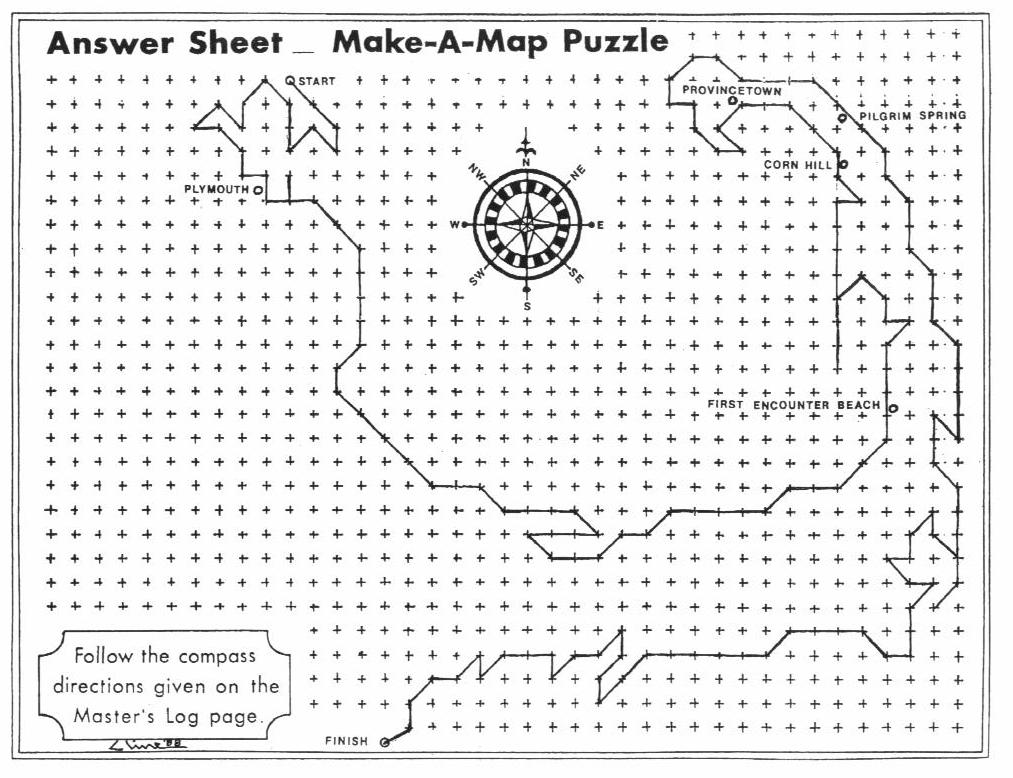
Make-a-Map Puzzle
If your student completes the puzzle correctly, he will have charted the Pilgrims’ voyage. You will need the Puzzle Page (and possible Solution).
Talk Like a Pilgrim
Good morrow!
Mayflower Compact
Exercise for students.
Books

Stories of the Pilgrims {Free eBook & Activities}
The author artfully weaves the stories of the Pilgrims’ journey together in a way that is interesting to young readers. One of our favorites!
Printables and Notebooking Pages
The Ship — Mayflower
Illustrated diagram for notebook.
Keep Reading

Activity: Storytelling Prompts
Storytelling prompts encourage a student step-by-step through the process of creating his own story.

Nests & Eggs: Wild Turkey
Nests & Eggs: Wild Turkey. Common bird we associate with Thanksgiving. Resources & free notebooking pages.

Official Pilgrim Guide Book to Plymouth ~ Free eBook
Enjoy this Official Pilgrim Guide Book to Plymouth! Full of illustrations and photographs. Free eBook