
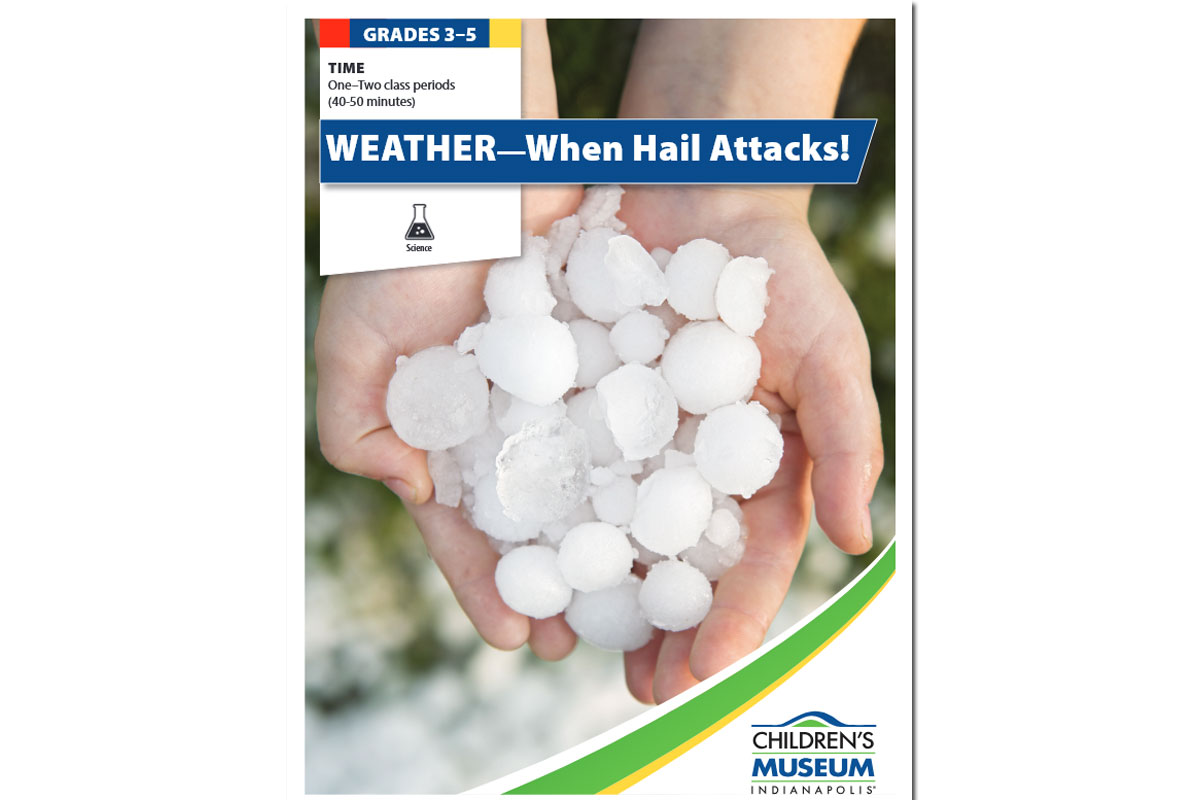

We took a look at water. Now let’s explore hail with this activity download from the Children’s Museum in Indianapolis.
This 6-page download includes two lessons aimed at grades 3–5 to learn:
- How thunderstorms create hail.
- Why hail changes in size.
- How researchers monitor hail formation.
- How engineers might protect public structures from hail damage.
There are two experiments: one explores hail size by having students create a “hail pad” to measure impacts. The other experiment has students create and test “hail shields.”
How Does Hail Form?
When moist air is cold enough, condensed water transforms into ice crystals. These frequently turn back into water before they reach the ground. When they do not melt into rain, they fall as snowflakes.
In the case of hail, condensation forms water droplets that then rise and freeze in the colder upper air. So the moisture falls as frozen raindrops or flakes of snow with ice.
Hailstones are therefore simply frozen raindrops, or else flakes of snow surrounded by ice. Hail is caused by the drops being blown upward instead of falling downward, and thus being carried into the colder moist upper air. True hail occurs only when the updraft of air is very powerful.
Hailstones are frequently carried upward several times after they have begun to fall; and as they receive a fresh coat of ice every time this happens, they may become very large. If a large hailstone is carefully cut in two the separate coats can be seen.
“Clouds, Rain and Snow, Dew, Mist and Fog, Hail and Sleet,” The Book of Knowledge
Great resource…and free!
Free Resource
Suggestions
Have your students do one or more of the following:
- Review the three forms of water.
- What is condensation? What role does it play in the formation of hail?
- Have your students create a hail notebook to contain experiment pages, notes, narrations, and other information.
- Narrate the process of the formation of hail.
- Use drawing and writing paper to copy the illustration on page 3 of the handout and label.
- Explain why hail would be more likely to form during a thunderstorm.
- Study the different types of clouds. Which type is most likely to allow the formation of hail?
- Extend the study with our free unit on hail.
Additional Resources
Hail Size Comparison Chart
Colorful illustrated chart from NOAA with a ruler at the bottom to measure your own.
Keep Reading

Free Nature Studies: Water and Ice
Glaciers smoothed down mountains, built up hills, carved out lakes, and formed rivers. Unit resources.


Gilbert Weather Bureau (Meteorology) ~ Free eBook
Gilbert Weather Bureau (Meteorology) for Boys is a free eBook and introduction to all things weather (for boys and girls, of course).